HOME    •    SEARCH      •      EMAIL    •     ABOUT  •     DONATE


Family • Malvaceae
Bulak na bundok
Gossypium arboreum L.
TREE COTTON

Shu mian

Scientific names Common names
Gossypium albiflorum Tod. Bukal (Tagabawa)
Gossypium anomalum G.Watt. Bulak na bundok (Tagalog)
Gossypium arboreum L. Bulak na totoo (Tag.)
Gossypium arboreum f. albiflorum (Tod.) Roberty Gapas (Bisaya)
Gossypium arboreum var. cernuum (Tod.) Hutch. & Ghosh . . . Kapas (Ilocano)
G. arboreum var. wightianum (Tod.) M.R.Almeida Desi cotton (Engl.)
Gossypium asiaticum Raf. Tree cotton (Engl.)
Gossypium cernuum Tod.  
Gossypium comesii Sprenger.  
Gossypium figarei Tod.  
Gossypium glabratum Tod.  
Gossypium gracile Salisb.  
Gossypium herbaceum var. wightianum (Tod.) T.Cooke  
Gossypium indicum Lam.  
Gossypium intermedium Tod.  
Gossypium macranthum Tod.  
Gossypium nanking Meyen . . .  
Gossypium neglectum Tod.  
Gossypium obtusifolium Ro9xb. ex G.Don . . .  
Gossypium perennans Delile ex Roberty  
Gossypium puniceum Fenzl  
Gossypium roseum Tod. . . .  
Gossypium roxburghii Tod.  
Gossypium royleanum Tod.  
Gossypium rubicundum Roxb. ex Wight & Arn.  
Gossypium rubrum Forssk.  
Gossypium sanguineum Hassk.  
Gossypium arboreum is an accepted species. KEW: Plants of the World Online

Other vernacular names
AYURVEDA: Kaarpaasi.
CAMBODIA: Krabas tes.
CHINESE: Shu mian.
FRENCH: Coton, Cotonnier, Coton arborescent, Cotonnier rouge.
INDIA: Kapas, Rui, Tula.
INDONESIAN: Kapas merah (general), Kapas beureum ( Sundanese), Kapas jawa (Javanese).
PORTUGUESE: Algodoeiro, Algodoeiro arboreo.
SWAHILI: Pamba.
THAILAND: Faai daeng.
VIETNAM: B[00]ng c[or], Bong hang ni[ee]n.

Gen info
- Malvaceae, or the mallows, is a family of flowering plants containing about 244 genera with 4225 known species. Well known members of economic importance include cacao, cola, cotton, okra, roselle, and durian. (3)
- Gossypium is a genus of flowering plants in the tribe Gossypieae of the mallow family, Malvaceae, from which cotton is harvested. It contains about 50 species, the largest genus in the tribe. The origin of the genus dates back to around 5-10 million years ago.
- Etymology: The genus name Gossypium derives from the Arabic word goz, referring to a soft substance.
- Cotton is the primary natural fiber used by humans, accounting for about 80% of world natural fiber production, and considered the most important group of fiber plants in the world. Cultivation of cotton yields a major oilseed crop and a main protein source for animal feed. Of the commercial species of cotton plant, G. hirsutum is source of 97% of world production, G. barbadense (1-2%), and G. arboreum and G. herbaceum (together ~2%).
- The oldest evidence of use of cotton as fiber plant in the Old World was found in Pakistan, and probably refers to G. arbboreum, estimated to date from about 2300 BCE. (•) Archaeological evidence suggests use for fabric production way back the Harappan civilization (ca. 2500 BCE).
- Gossypium cotton refers to all 4 cultivated Gossypium species: Gossypium arboreum, G. barbadense, G. herbaceum, and G. hirustum.

Botany
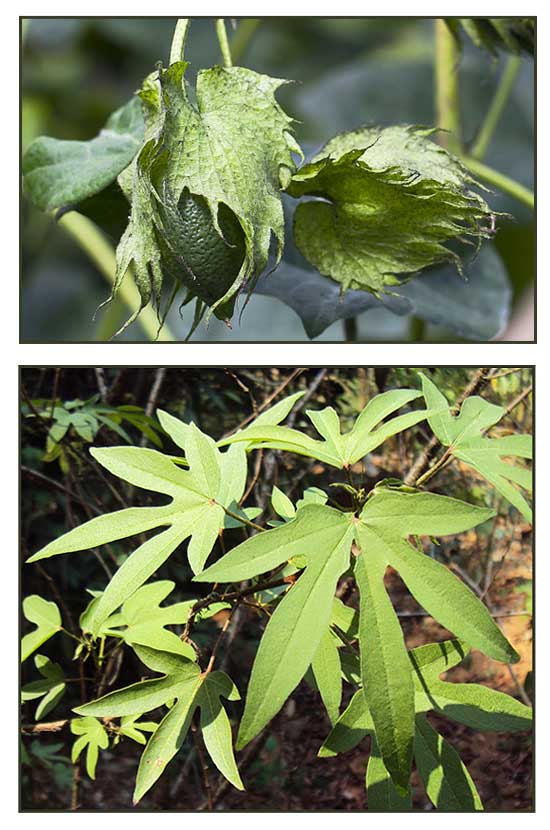
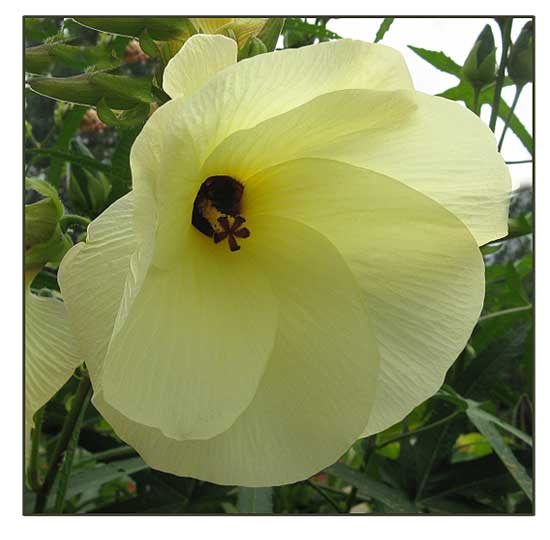
• Shrubby plant up to 2 m tall with purple branches; leaves 5-7 parted with linear to lanceolate lobes; flowers purple or yellow with purple center; epicalyx segments large, ovate, subentire or toothed; capsule up to 2.5 cm across, ovoid or oblong. (eFloraofIndia)

• Shrubs, ca. 1.5-3 m tall; young branches purple pubescent with stellate and few simple hairs, glabrescent. Leaves simple, alternate, spiral; stipules liner to lanceolate, often flacate; petioles ca. 1.5-18 cm long, puberulent and villous; lamina ca. 3-13 x 3.5-12 cm, palmately lobed to palmatifid, ovate or orbicular or oblong segments, lobes subrotundate to triangular, cordate at base, acute at apex, crenate to dentate, secondary nerves 5-7 pairs. Flowers solitary, axillary or in terminal racemes by reduction of upper leaves; Epicalyx segments large ovate, subentire or toothed, cordate at base, acute at apex; calyx ca. 5 mm long, cupular, somewhat 5-dentate; corolla ca. 3-4 cm long, pale yellow with or without purple center, and sometimes entirely purple; staminal tube ca. 1.5-2 cm long, antheriferous. Capsules ca. 1.5-3 cm in diam., depressed globose, pubescent, enclosed by calyx; mericarps 20-40, ca. 4 mm across, longitudinally sulcate. Seeds 5-8 per cell, ca. 5-8 mm in diam., free, ovoid, with dense covering of long woolly white or rusty hairs. (India Biodiversity Portal)

Distribution
- Native to the Philippines. (1)
-
POWO lists it as native to India and Sri Lanka. (2)

Constituents
- GC-MS analysis dried leaves for essential oil GC-MS showed yield of 0.05% of a colorless EO with strong odor, and identified 28 constituents representing 100% of the oil. Major components were
n-hexane (28.32%), 2-ethyloxetane (25.26%), pentane-3-methyl (18.50%), and cyclopentane methy (14.36%). Classes of compound were: aliphatic hydrocarbon (66.25%), monoterpene hydrocarbons (3.21%), sesqueterpenoids (0.44%), oxygenated monoterpene (0.08%), and organosilicon compounds (0.38%). (see study below) (9)

Properties
- Studies suggested wound healing, fibroblast growth stimulation, antidiabetic, α-glucosidase, α-amylase inhibitory, antioxidant, anti-ulcerproperties.

Parts used
Roots, leaves.

Uses

Edibility
- Leaves reportedly edible.
- Seeds yield a large amount of oil, used as substitute for olive oil.
Folkloric
- No reported folkloric medicinal use in the Philippines.
- Root and root bark traditionally used to stimulate menstrual flow, regulate menstrual disorders, induced labor and delivery, and help expel the placenta.
- Root and root bark used as herbal anti-fertility agent by both men and women. Decoction used as topical wash for burns, wounds, and ulcers. Decoction or juices used for fevers, headaches, nerve pain, dysentery, and diarrhea.
- In African traditional medicine, root considered an emmenagogue and to cause uterine contractions. In Ghana and Nigeria, root or root back extract is taken as abortifacient. In Ethiopia, infusion of powdered root bark drunk for treatment of lymphatic swellings. In Madagascar, root decoction taken against hemorrhage. In Cote d-Ivoire, young leaves in lemon juice drunk to treat constipation; but in Ghana, cold infusion of leaf with lime juice used for treatment of dysentery. In Ghana, macerated leaf taken against vomiting; fresh leaf sued for treatment of ulcers as covering or as powder dressing after heating with fruit of Piper guineense. In Cameroon, leaf decoction drunk for treatment of typhoid fever. In Nigeria, flowers used for treatment of dysentery. In Mauritius, bark and seeds used against tumors. (10)
- In Ghana, leaves used for wound healing. Leaf and crushed seeds applied to sores and used as poultices for bruises and swellings. Paste of grounds seeds is applied against headache. (10)
- Seeds consumed as anticatarrhal; also for chronic cystitis and as anti8gonorrhoeic. Roots used as febrifuge. Leaves used as uterine stimulant. (12)
Others

- Commerce: While G. arboreum is not the cotton of choice for large-scale commercial farming, its historical significance, resilience to challenging environments, and potential for low-cost farming make it a valuable species in the modern world, and offers an enviromental and socially beneficial alternative and opportunity especially for smallholder farmers in regions vulnerable to climate change. (13)

Studies
• Wound Healing / Fibroblast Growth Stimulation / Leaves:
Study evaluated the wound healing and antibacterial activity of aqueous extract of Gossypium arboreus leaves and Ficus asperifolia bark against Staphylococcus aureus, Bacillus subtilis, Micrococcus flavus, Escherichia coli, Pseudomonas aeruginosa and resistant strains of S. aureus, and the effect of the plant on fibroblast growth stimulation and antioxidant protective effect against hydrogen peroxide induced damage. Extracts showed weak antibacterial action against all bacteria tested. Extracts showed significant (p<0.001) effects on growth of human dermal fibroblast at 50 mcg/ml and lower, and significantly protected fibroblast cells against oxidative damage. G. arboreum leaf extract exhibited higher activity. The stimulatory effect on fibroblast growth and protection against peroxide-induced oxidative damage provide support as wound-healing agents. (7)
• Antidiabetic / α-Amylase and α-glucosidase Inhibitory / Leaves: Study evaluated the α-amylase and α-glucosidase inhibitory potential of aqueous, ethanolic and acetone leaf extracts of G. arboreum. The aqueous and acetone extracts exhibited potent α-amylase inhibitory activity with IC50 of 10.10 mg/mL and 2.75 mg/mL respectively. Extracts likely contain non-competitive inhibitors of both enzymes. Inhibitory activity was attributed to tannins and steroids. (8)
• Antioxidant / Essential Oil / Dried Leaves: Study evaluated the antioxidant activity of essential oil extracted from air-dried leaves. GC-MS analysis of EO showed yield of 0.05% of a colorless EO with strong odor, and identified 28 constituents representing 100% of the oil. The EO showed antioxidant activity by DPPH with 71.70%, 81.53%, and 88.22% inhibition at concentrations of 0.1, 0.2, and 0.3 mg/mL respectively. Activity was attributed to oil constituents such as limonene, γ-terpinene, and caryophyllene. (see constituents above) (9)
• Antiulcer / Leaves: Study evaluated various leaf extracts of G. arboreum for antiulcer activity in aspirin-induced and pylorus-ligated rats. Chloroform, alcoholic, and aqueous extracts at 500 mg/kg exhibited preventive efficacy against gastric ulceration in rats. The alcoholic extract showed significant activity. Effects were compared with standard drug Omeprazole. (11)

Availability
- Wild-crafted.
- Seeds, dried leaves, extracts, and live plants in the cybermarket.

October 2026

                                                 PHOTOS / ILLUSTRATIONS
IMAGE SOURCE: Gossypium arboreum - Tree cotton / by Len Worthington / CC BY-SA 2.0 Generic / Image modified / Click on image or link to go to source page / Wikimedia Commons
OTHER IMAGE SOURCE: Gossypium arboreum - Developing seedpods / by Poco a poco / CC BY-SA 3.0 / Image modified / Click on image or link to go to source page / Useful Tropical Plants
OTHER IMAGE SOURCE: Gossypium arboreum - Close-up of flowers / by KENPEI / CC BY-SA 3.0 / Image modified / Click on image or link to go to source page / Useful Tropical Plants
OTHER IMAGE SOURCE: Gossypium arboreum - Leaves / by Vinayaraj / CC BY-SA 3.0 / Image modified / Click on image or link to go to source page / Useful Tropical Plants
IMAGE SOURCE: Gossypium arboreum - Tree cotton / by Agnieszka Kwiecien, Nova / CC BY-SA 4.0 International / Image modified / Click on image or link to go to source page / Wikimedia Commons

Additional Sources and Suggested Readings
(1)
Malvaceae: Gossypium arboreum / Co's Digital Flora Database
(2)
Gossypium arboreum /
KEW: Plants of the World Online
(3)
Malvaceae / Wikipedia
(4)
Gossypium / Wikipedia
(5)
Gossypium arboreum / Wikipedia
(6)
Gossypium arboreum / Ken Fern: Tropical Plants Database / Useful Tropical Plants
(7)
Antibacterial, antioxidant and fibroblast growth stimulation of aqueous extracts of Ficus asperifolia Miq. and Gossypium arboreum L., wound-healing plants of Ghana / Kofi Annan, Peter J Houghton / J Ethnopharmacol, 2008; 119(1): pp 141-144 / DOI: 10.1016/j.jep.2008.06.017
(8)
Inhibitory potential of Gossypium arboreum leaf extracts on diabetes key enzymes, α-amylase and α-glucosidase / Mutiu Idowu Kazeem, Stella Gbemisola Abimbola, Anofi Omotayo Tom Ashafa / Bangladesh Journal of Pharmacology, 2013; 8(2)
(9)
GC-MS Analysis and Antioxidant Activity of the Essential Oil Constituents from the Dried Leaves of Gossypium arboreum Linn / Delight Tobilola Adesanwo, Babajide Joseph Adisa, Daniel Ayodele Idowu, Favour Segun Fabuyi et al / Journal of Medical Science, Biology, and Chemistry, 2025; 2(2): pp 180-185 /
DOI: 10.69739/jmsbc.v2i2.954
(10)
Gossypium arboreum / PROTA4U
(11)
Anti-ulcer activity of leaves of Gossypium arboreum Linn. in aspirin induced rats and pylorus legated rats / Kalpana Patil, S Kumar, Dr Yogendr Bahuguna, DS Hugar et al
(12)
Gossypium arboreum / IndianMedicinalPlants
(13)
Tree Cotton (Gossypium arboreum) / Mavronero

•

DOI: It is not uncommon for links on studies/sources to change. Copying and pasting the information on the search window or using the DOI (if available) will often redirect to the new link page. (Citing and Using a (DOI) Digital Object Identifier)

                                                            List of Understudied Philippine Medicinal Plants
                                          New plant names needed
The compilation now numbers over 1,830 medicinal plants. While I believe there are hundreds more that can be added to the collection, they are becoming more difficult to find. If you have a plant to suggest for inclusion, native or introduced, please email the info: scientific name (most helpful), local plant name (if known), any known folkloric medicinal use, and, if possible, a photo. Your help will be greatly appreciated.
•

•
HOME      •      SEARCH      •      EMAIL    •     ABOUT