|
Gen info
- Araceae is a family of monocotyledonous flowering plants in which flowers are borne on a type of inflorescence called a spadix. Also known as the arum family, members are colloquially known as aroids. The family contains 114 genera and about 3,750 known species. (39)
- Alocasia is a genus of rhizomatous or tuberous, broad-leaved, perennial, flowering plants from the family Araceae. As of August 2026, it is listed to contain 91 accepted species native to tropical and subtropical Asia. Around the world, a range of hybrids and cultivars are cultivated as ornamentals. (40)]
- Etymology: The genus name Aloocasia derives from Greek terms a- "not" and kolakasia "lotus root", alluding to its similarity to Colocasia, a closely allied genus. The specific epithet macrorrhizos is Greek, meaning "large roots", referring to the thick, root-like stems.
 Botany
• Biga is a coarse and erect plant with a stout
trunk, growing up to 2 meters high. Leaves are very large, broadly
ovate, the larger ones up to 1.5 meters long, with slightly undulate margins, a pointed apex
and a deeply cordate base, not at all peltate. Petioles are long and very stout. Spathes are
peduncled, with the tube 4 to 5 centimeters long, the blade yellowish to yellowish-green
up to 23 centimeters long and 9 centimeters wide when spread, slightly mottled with purple inside. Pistillate part of the spadix
is 3 to 4 centimeters long, 1.5 centimeters thick, contracted above. Fertile part of the male inflorescence is about 6 centimeters long, the appendage about 15 centimeters long.
Berries are globose or ovoid, fleshy, and red when mature.
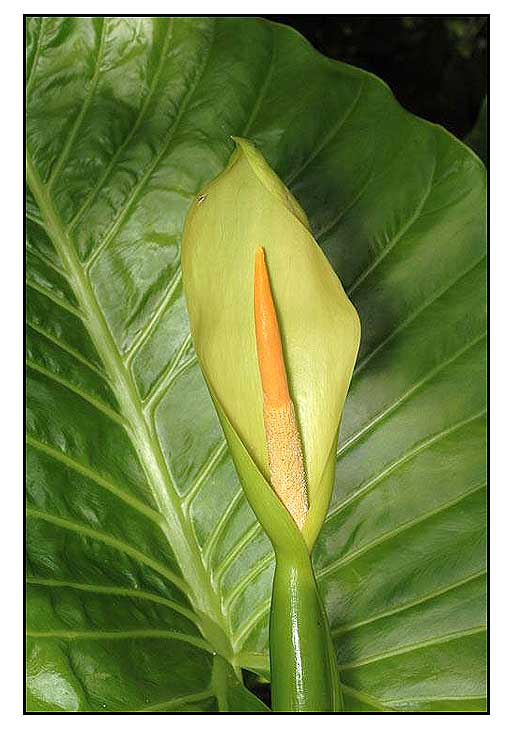
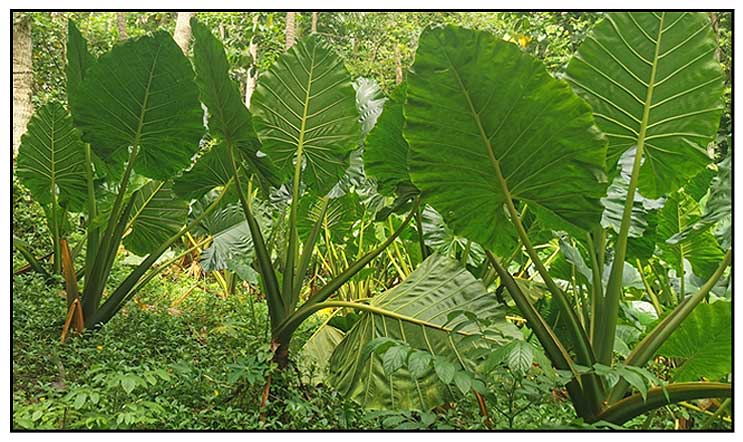
• Growth form: It is a perennial herb that can reach up to 4 m, usually solitary, with 0 - 2 offshoots from the base. Foliage: The leaves are held upright and arranged in a rosette at the tip of the stems. The petioles (leaf stalks) can grow up to 1.3 m long. The leaf blades are rounded, arrowhead-shaped, bluntly triangular in shape, growing up to 1.2 m long and 0.5 m wide. The sinus (indentation where the leaf stalk connects to the lateral lobes in aroids) is naked or open, with no connecting leaf blade between the posterior/lateral lobes. Stems: The stems are underground corms (thick, often round, modified stems) that elongate as the plant ages, either growing erect or decumbent (lying along the ground with the leafy shoot curving upwards). Flowers: The inflorescence is an off-white spadix comprising of an appendix (a sterile rod-like upper portion of the spadix) and tiny fertile flowers in the lower portion. The appendix is equal to or exceeds half the length of the entire spadix. The spadix is subtended by a spathe; an upper portion is open, white to yellowish-green, and a bulbous, green enclosed portion surrounds the female flowers, separated by a tight 'waist'. The upper portion of the spathe becomes hood-like when the male flowers mature. The peduncle (inflorescence stalk) barely extends beyond the cataphyll (leaf-like structure that surrounds and protects a newly emerging leaf blade in aroids). Fruit: The infructescence is composed of multiple ellipsoid berries that turn red when ripe. The bulbous portion of the spathe peels back as the fruit mature. (Flora & Fauna Web)
Distribution
- Native to the Philippines. (15)
- Listed as "cryptogenc" in Leonardo Co's database. (38)
-
Wild in clearings and secondary forests
at low and medium altitudes throughout the Philippines.
- Also native to Bismarck Archipelago, Borneo, Maluku, New Guinea, Queensland, Solomon Is., Sulawesi. (15)
- Commonly cultivated as an ornamental here and in other tropical countries
- Cultivated for its starchy stem tubers.
 Constituents
- Plant yields flavonoids, cynogenetic glycosides, ascorbic acid, gallic acid, mallic acid, oxalic acid, alocasin, amino acids, succinic acid, and ß-lectins.
-
Rhizomes contain phytosterols,
alkaloids, glucose and fructose.
- Root tuber contains neurotoxin, sapotoxin.
- Study has yielded alocasin, an antifungal and trypsin inhibitor.
- Study isolated a new ceramide, alomacrorrhiza A, from an ethanolic extract, which was elucidated as (2S, 3S, 3R)-2A/-[(2'R)-2'-hydroxy-hexacosanoyl]-tetradecane-1,3,4-triol. (5)
- Stems, corms, leaves and petioles contains numerous, needle-like, stinging crystals of calcium oxalate (raphides).
- Investigation for chemical constituents yielded 9 compounds identified as: linoleic acid (1),glycery1--palmitate (2),-sitosterol (3), daucosterol (4), gigantine A (5), Apigenin-8-C-β-D-glucoside (6), Quercetin-3-O-α-L-rhamnoside (7),6-O-palmitoly glucose ester (8),gigantine B (9). (20)
- Study of rhizomes yielded nine compounds viz., glycosmisic acid (1), N-trans-feruloyltyramine (2), grossamide (3), protocatechuic acid (4), borneol acetate (5), vanillic acid (6), methyl 4-hydroxybenzoate (7), ß-daucosterol (8), and ß-sitosterol (9). (29)
- Proximate analysis of C. indica edible tubers, rhizomes, corm, roots and stems (g/100g DW) yielded moisture 89.01%, crude protein 6.34 ± 0.21, crude lipid 4.31 ± 0.11, crude fiber 5.78 ± 0.08, ash 3.14 ± 0.01, N free extractives (NFE) 80.43, calorific value kJ/100 DM 1611.54. (34)
-
Mineral composition of edible tubers, rhizomes, corms, roots, and stems (mg/100 g) yielded sodium 21.1 ± 0.28, potassium 979 ± 0.13, calcium 154 ± 0.13, magnesium 134 ± 0.08, phosphorus 89.0 ± 0.03, zinc 0.89 ± 0.01, manganese 1.21 ± 0.04, iron 11.53 ± 0.12, and copper 3.36 ± 0.08. Starch and vitamin content analysis yielded starch 34.00 ± 0.14 g/100g, niacin 9.34 ± 0.11 mg/100g, and ascorbic acid 5.59 ± 0.24 mg/100g. (34)
- Nutritional value of 100 grams of raw Giant taro yields 70 gm of water, 100 calories, 2.2 grams of protein, 0.1 gm of lipid fat, 23 grams of carbohydrate and 1.9 grams of dietary fiber.
Vitamin yield per 100 grams is 0.02 mg Vitamin B1, 0.02 mg Vitamin B12, 17 mg Vitamin C, and 2 mg Vitamin E. Mineral yield is 38 mg of calcium, 0.8 mg iron, 52 mg manganese, 267 mg potassium, 30 mg of sodium, and 1.6 mg zinc. (35)
Properties
- See Toxicity below.
-
Leaf considered astringent, styptic, antitumor.
- Rootstock considered laxative, diuretic.
- Experimentally considered antimicrobial, antifungal, antioxidant, hepatoprotective, antidiarrheal, antiprotozoal, anticancer.
- Studies have suggest antioxidant,
antifungal, antiviral, neurotoxicity, anticancer, antidiabetic, antidiarrhea, diuretic, hepatoprotective, larvicidal, antimicrobial, anti-fertility, antibacterial, anthelmintic properties.
Parts used
Stems, leave, rhizomes.
Uses
Edibility
-
Stems and corms are edible; used as food during
scarce times.
- Widely cultivated and eaten as vegetable throughout Bangladesh.
- Requires prolonged cooking due to raphides or calcium oxalate crystals, which may cause lip or buccal irritation.
- In India, rhizomes and leaves used as ingredient in fish curry. (31)
- Rhizome is a source of starch or flour.
(see studies below: 43, 44)
- Binagol, a Filipino sweet delicacy is made from mashed giant taro corms and coconut milk.
Folkloric
• Leaves and
corms used for furuncles, impetigo and snake bites
• Ground petioles in near-decayed state are placed in cloth and
heated in coals, used for toothaches.
• Decoction of rhizomes used for abdominal pains and vomiting.
• Acrid juice used for stings of giant nettles (Laportea).
• Tubers used for influenza, fever, malaria, diarrhea, typhoid fever, tuberculosis, headaches.
• Rootstock used for inflammations and diseases of the abdomen and spleen.
• Leaf and stem decoction used as bath in treatment of pruritic skin conditions and burns.
• Underground stem part used for gout and rheumatism.
• In Bangladesh, used in the treatment of diabetes; stem juice applied to prevent edema, pain, and bleeding from cuts and wounds. Whole plant is used for pus in the ears, jaundice, and constipation.
• In Java, chopped
roots and leaves applied to painful joints.
• In India, rhizomes
are rubefacient; employed as external stimulant and for fevers.
• In Vietnam used to treat inflammation, eczema and abscesses. Used to treat gout, flu, and beriberi.
• Used for treatment of insect bites by Australian aboriginal people.
• In China, used for cancer treatment.
• In Indonesia, leaves and tubers used to relieve joint pains and promote wound healing. In Vietnam and Cambodia, tubers used to promote urination, heal boils, and treat rheumatism. (30)
• In India, the Zeliang tribe of Nagaland apply exuded liquid from rhizomes and leaves mixed with cow or buffalo's milk on snake bite to remove poison. (31)
• In Malaysia, juice applied to stings of giant nettle. Sap from petioles used to treat cough. Chopped leaves and roots applied to painful joints; used as rubefacient. In Papua New Guinea, young leaves and sap used to treat headaches. In India, corm used to treat scorpion stings, gout, and rheumatism. (36)
• In Thailand, rhizome is applied to snakebites and wounds. In Papua New Guinea, young leaves and sap used externally for headaches; leaves cooked in coconut milk and eaten to treat sexual insufficiency. Boiled stems used as laxative. Chooped-up roots and leaves used as rubefacient. Petiole juice used against cough. (42)
Others
• Fodder: In tropical America, used to feed pigs and farm animals. Root and leaf meal also used for feeding poultry. (36)
Studies
• Antifungal / Anti-HIV1 Reverse Transcriptase:
Alocasin, an anti-fungal protein was isolated from the rhizome of Alocasia
macrorrhiza. and showed antifungal activity against Botrytis
cineria. Alocasin also reduced the activity of HIV1 reverse transcriptase. (1)
• Neurotoxicity / Sapotoxin:
A case report of poisoning due to the raw root tuber of Chinese medicinal
plant, A macrorrhiza, presenting with severe pain and numbness periorally,
with nausea, vomiting and abdominal pain. Root tuber is known to contain
the neurotoxin, sapotoxin. (2)
• Anti-Tumor:
In a study of the antitumor effect of water extract of Alocasia macrorrhiza, the inhibitory rate was 29.38% against S180 in mice and 51.72% against transplantable human gastroadenitis in nude mice. No antitumor effect was seen against ECA in mice. (3)
• Hepatorenal Effects / Concerns:
Plant extract was studied for effects on hepatorenal functions in mice. After treatment, RBC, Hb, protein, albumin and globulin were significantly decreased while AST, ALT, GGT, LDH, creatinine, total lipid and cholesterol were significantly increased after treatment and recovery period of 10 days. Histopath changes noted after treatment disappeared after a recovery period of 20 days. However, vascular congestion persisted. The high LD50 of the reversible action of the plant require more studies before recommendations are made regarding its safety as a medicinal plant. (4)
• Alternative to Soybean Meals for Sows:
A study in Vietnam evaluated the benefits of growing Taro for feeding sows. Results showed that even on low-fertility soil the yields of foliage and roots were high (200 and 20 tonnes/ha fresh basis, respectively in 200 days, estimated at 100 million VND (about US $ 5,000 per hectare), almost five times more than from rice. The boiled leaves replaced 50% or all of the protein from soybean meals in diets based on rice bran and broken rice. Results concluded Giant Taro can be a complete replacement for soybean meal in the diets of Mong Cai sows. (9)
• Diuretic / Laxative: Study evaluated the laxative and diuretic effect of leaves extract in rats. An ethanolic extract produced significant dose-dependent laxative and diuretic activities. (10)
• Hepatoprotective / Antioxidative / In Vitro Study: Study evaluated the antioxidative and hepatoprotective property of A. macrorrhiza leaf juice. Results from TBARS and Glutathione assays conclude the leaf juice as a whole possesses hepatoprotective and antioxidative properties when tested in vitro using rat liver slice model with hepatic damage induced by CCl4 and Tylenol. (11)
• Anti-Cancer Potential / Human Hepatocellular Carcinoma Cells: Study showed Alocasia macrorrhiza extract has potential cytotoxic and apoptotic effect on human hepatocellular carcinoma cells and inhibits hepatoma growth in vitro. Mechanisms might be associated with inhibition of DNA synthesis, cell cycle arrest, and apoptosis induction. (12)
• Larvicidal / Pupicidal: Study evaluated the larvicidal and pupicidal potential of methanolic extracts of plant leaves against malarial vector Anopheles stephensi mosquitoes. Results showed the plant leaf extracts to be effective mosquito vector control agents with a potential for use in integrated pest management programs. (13)
• Antihyperglycemic / Antioxidant / Cytotoxic: Study evaluated a methanolic extract for antihyperglycemic, antioxidant, and cytotoxic effects. In alloxan-induced hyperglycemic mice, it produced a significant decrease in blood glucose levels (<P.0.05). Extract also showed antioxidant potential and cytotoxic effects on brine shrimp lethality assays. (14)
• Antioxidant / Cytotoxicity / Antimicrobial / Anthelmintic: Study investigated the antioxidant, antimicrobial, thrombolytic, cytotoxic, and anthelmintic activity of methanolic extract of A. macrorrhizos and its various fractions. The methanolic extract showed highest free radical scavenging activity by DPPH assay. ME and carbon tetrachloride fraction showed good antimicrobial activity. Methanolic crude extracts showed cytotoxic activity in brine shrimp lethality assay and anthelmintic activity using the Pheretima posthuma model. (16)
• Antidepressant: Study of a hydroalcohlic extract of A. macrorrhizos showed antidepressant activity with significant reduction of immobility in standard animal models (forced swim test and tail suspension test). Effect was comparable to Imipramine. (17)
• Negative Lipid Lowering Effects / Leaves: Study a hydroalcoholic extract of leaves of Alocasia macrorrhizos in cholesterol-rich high-fat diet induced hyperlipidemia in rats. Results showed significant reduction in triglyceride and VLDL-C levels; however, it increased LDL-C, which makes it unsuitable as a lipid lowering agent. (18)
• Antioxidant: Study evaluated various solvent extracts of different edible parts of Alocasia macrorrhiza and Alocasia fornicata. Maximum antioxidant activity was observed in the diethyl ether extract of both species, comparable to the quercetin and ascorbic acid standards. (19)
• Anticancer Potential: Study evaluated the anticancer effect of aqueous extract of A. macrorrhiza against hepatic cancer. Results showed proliferation inhibition and apoptosis effects on human hepatocellular carcinoma cells in vitro and inhibition of hepatic growth in vivo. The mechanism might be associated with the inhibition of DNA synthesis, cell cycle arrest, apoptosis induction through up-regulation and down-regulation of various genes. (21)
• Toxicity to Lepidopteran Insects: Study evaluated the toxic effects of crude extracts of A. macrorrhiza lectin on larvae of cabbage butterfly (Pteris rapae), asiatic corn borer (Ostrinia fumacalis) and tobacco cutworm (Spodoptera litura). Results showed a stomach toxic effect on the larvae of cabbage butterfly. (22)
• Toxicity and Antifertility Effects: Study evaluated Alocasia macrorrhiza and Calotropis procera plants as potential substitute to chemical rodenticides in male albino mice. Results showed both leaf extracts, administered in high doses and for a prolonged period of time, have hepato-renal and testicular toxic effects. The leaf extracts yielded toxic compounds including alkaloids, glycosides, anthraquinones, flavonoids, tannins, organic acids and toxic minerals which either inhibit or arrest spermatogenesis which can lead to mice infertility. (23)
• Hepatoprotective
/ CCl4 and Acetaminophen Hepatotoxicity / Leaf Juice: Study evaluated the antioxidative and hepatoprotective efficacy of Alocasia macrorrhiza leaf juice in an in vitro liver slice model with hepatic damage induced by hepatotoxins CCl4 and Tylenol. Results from TBARS and Glutathione assays suggested hepatoprotective and antioxidative efficacy of the leaf juice. There was remarkable decrease in the leakage of AST, ALT, and ALP in the medium. (24)
•
Antioxidant / Antidiarrheal / Cytotoxic / Antibacterial / Tuber: Study evaluated an ethanol extract of tuber of Alocasia indica Schott in different in vitro and in vivo experimental models. The extract showed strong radical scavenging activity in DPPH assay and strong reducing power in a concentration dependent manner. Extract showed significant (p<0.01) increase the latent period and decreased defecation in both castor oil- and magnesium sulfate-induced diarrhea. There was potential antibacterial activity against all tested bacteria in disk diffusion assay. On cytotoxicity testing, there was 50% lethal concentration against brine shrimp nauplii at 81.09 µg/mL. (25)
• Diuretic / Leaves: Study evaluated the diuretic activity of hydroalcoholic extract of leaves of Alocasia macrorrhizos in Wistar rats. Results showed diuretic activity as evidenced by a significant (p<0.05) dose dependent increase in urine volume. At 500 mg/kg, there was increase excretion of sodium along with decreased excretion of potassium. Further studies are suggested for mechanism of action to validate the finding. (26)
• Antidiabetic / Leaf and Stem: Study evaluated the effect of A. indica L. on blood glucose of normal and Streptozotocin-induced diabetic rats. Oral administration of of leaves and stems extracts for 21 days showed a significant (p<0.05) and dose dependent fall in blood glucose levels. (27)
• Negative Effect on Lipid Profile: Study evaluated the hypolipidemic effect of hydroalcoholic extract of leaves on cholesterol-rich high-fat diet induced hyperlipidemic in rats. Results showed that the leaf extract at dose of 250 and 500 mg/kg in rats significantly reduced triglycerides and VLDL-C levels; however, it increased LDL-C, which suggests it may not be suitable as a lipid-lowering agent. (30)
• Molluscicidal / Stems: Study of crude extracts of fresh stems of Alocasia macrorrhiza showed molluscicide potency as evidenced by significant mortality rate in Caucasotachea lencoranea (Mouss.) and Helicella candeharica. (32)
• Calcium Oxalate Reduction / Soaking in Sodium Bicarbonate Solution:
Study investigated the effect of sodium bicarbonate concentration, time, and temperature on calcium oxalate reduction in giant taro. The processing conditions to reduce calcium oxalate involved soaking giant taro corm chips in 2% w/v sodium bicarbonate solution for 20 minutes at ambient temperature. The process resulted in final calcium oxalate content in corm chips of about 67.67 mg/100 g, slightly below the threshold safe level of 71 mg/100g. (33)
• Antioxidant / Leaves: Phytochemical analysis of leaves yielded the presence of phenols, flavonoids, tannins, saponins, and alkaloids. Total phenolics content of leaves ethanol extract was 9.18 mg/100 mg; flavonoids was 2.30 mg/ 100 mg. Activity of ethanolic leaves extract by DPPH assay was concentration dependent; IC50s for ascorbic acid and leaf extracts were 24.44 and 48.58 µg/ml, respectively (37).
• Antibacterial / Anticancer / Rhizome Lectin: Study purified a heat-stable lectin (AML) from A. macrorrhiza rhizome. The lectin exhibits impressive stability and compatibility across a range of pH levels, denaturantsm and divalent ions. The AML exhibited noteworthy antibacterial potency against E. coli and S. dysenteriae. It exhibited moderate toxicity against brine shrimp nauplii with LD 50 values of 321 µg/mL. In vitro, thje AML suppressed proliferation of mice Ehrlich ascites carcinoma (EAC) cells by 35% and human lung cancer (A549) cells by 40% at 512 µg/ml concentration. In vivo, intraperitoneal injection of AML in doses of 2.5 and 5.0 mg/kg/day in EAC-bearing mice showed inhibition of EAC cell growth by 37% and 54%. (41)
• NaCl-Assisted Starch Extraction from Corms: Study reports on a NaCl-based starch extraction process from A. macrorrhizos corms using Response Surface Methodology and Artificial Neural Network modeling. The RSM-optimized process significantly enhanced starch yield to 83.88 g per 100 g dry corm, a 3.35-fold improvement from previous reported values. Overall, the optimized NaCl-based extraction process demonstrates strong potential for scalable and industrial starch production from A. macrorrhizos. (43)
• Potential for Designer Food Formulation: Study reports on a novel thermo-enzymatic strategy for improving Resistant Starch (RS) formation, along with assessing its in vitro digestibility, structural characterization and prebiotic effect under selected trace metal supplementation. Results showed modified giant taro starch markedly boosted cell wall hydrophobic in most of the probiotics. Findings highlighted a novel approach for increasing RS content with enhanced prebiotic performance under tract metal supplementation offering potential for designer food formulation (44)
• Biodegradable Plastic from Biga Tuber Starch: Study evaluated the potential of biga tubers starch as biodegradable plastic and compared the bioplastic from commercially produced plastic in measures of flammability, biodegradability, and tensile strength. Results indicate no significant difference by t-test analysis and suggest biga tuber starch as potential material for biodegradable plastics. (45)
Caution
/ Toxicity
• Stinging Raphides: Stems, corms,
leaves and petioles contain stinging raphides (calcium oxalate crystals)
that are destroyed by boiling and roasting.
• Neurotoxicity:
Case report suggests possible neurotoxicity caused by tuber root neurotoxin, sapotoxin. (sees study above) (2)
• Retrospective study: Retrospective study on A. macrorrhiza poisonings of 27 cases (25 leaf or tuber consumption, 1 eye contact, 1 skin contact) suggests sapotoxin and calcium oxalate as the toxic components. Primary symptom was sore throat redness with numbness of the oral cavity. Other complaints were salivation, dysphonia, abdominal pain, mouth cavity ulcers, dysphagia, thoracodynia. chest tightness and swollen lips.
(6)
Availability
- Wildcrafted.
- Cultivated for its starchy tubers.
|


