| Gen info
- The Marantaceae, the arrowroot or prayer plant family, are a family of flowering plants consisting of 28 genera and about 530 species, one of the most species-rich families in its order.
-
Donax is a monotypic genus of flowering plants, containing only one recognized species, Donax canniformis.
- Etymology: The genus name Donax derives from Ancient Greelk and Latin word for "reed." refferring to its tall, slender, jointed stems that grow in clumps like reeds in damp areas. The specific epithet canniformis derives from canna meaning "cane" and formis meaning "having the form of", referring to the segmented stems that resemble cane.
Botany
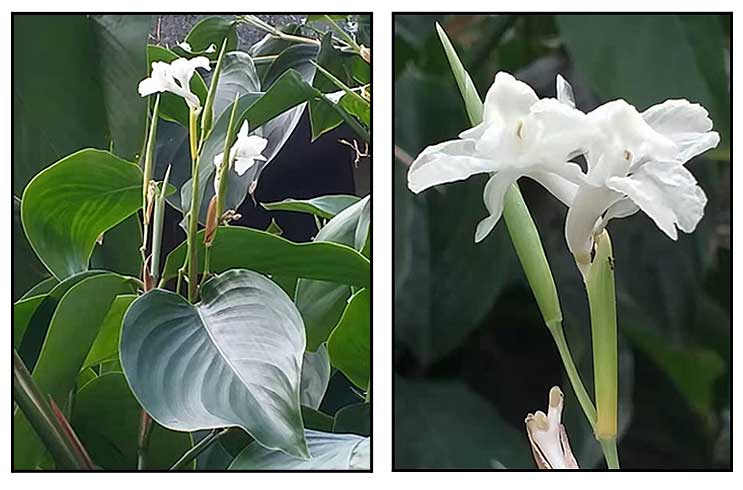
• Bamban is a rhizomatous shrub with stems up to
2 to 3 meters tall, several growing in a cluster, smooth, and widely branched.
Leaves are short-petioled, thin, smooth, ovate, 15 to 18 centimeters long and
9 centimeters wide. Petioles are about 1 centimeter long. Panicles are loosely- and few-branched. Calyx tube is about
1 centimeter long, with lanceolate segments which are acute and ribbed. Corolla lobes
are white, linear to oblong, and longer than the tube. Staminodes
are obovate and large, with the tip smaller, obovate and clawed. Anther,
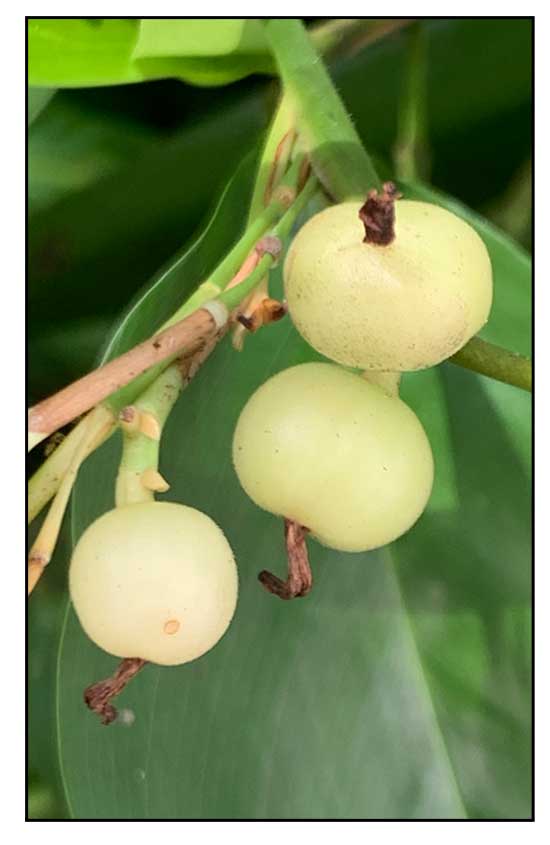
filament and lobe are linear. Fruit is globoid to ellipsoid, slightly
hairy, about 1 centimeter in diameter, and whitish. Seeds are oblong, grooved
and strongly wrinkled.
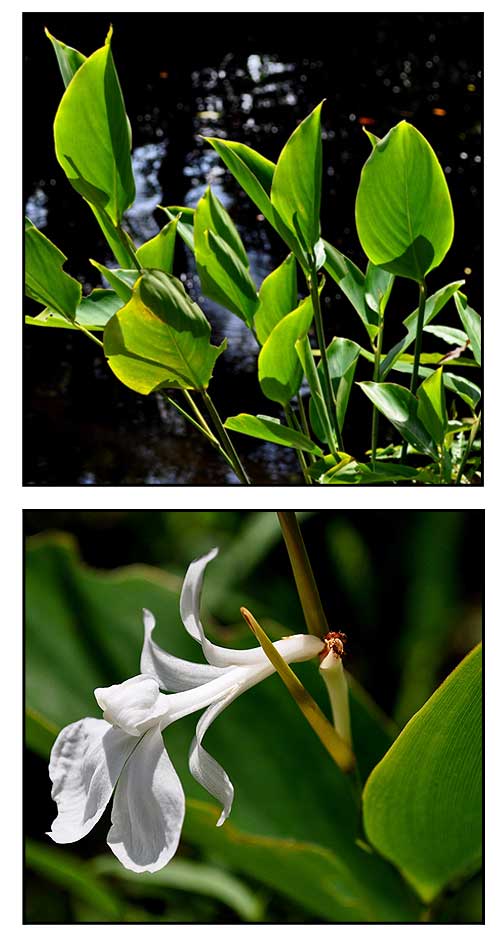
• A perennial, stout, tufted-rhizomatous, erect, shrub-like herb, 2—5 m tall, with true, slender, sympodially branching stems. Leaves all cauline, sheathed, thin-coriaceous; sheath up to 20 cm long; ligule very short; petiole 1—2.5 cm long, thickened into a cylindrical, pilose pulvinus; blade broadly ovate to elliptical, 10—45 cm x 4—25 cm, base rounded, apex acuminate, underside appressed-pilose along the midrib, lateral veins numerous, running parallel. Inflorescence terminal on a leafy branch, slenderly paniculate, up to 20 cm long, branched at base, partial inflorescences condensed cymose (spiciform) in the axils of primary bracts; bracts 9—11, distichous, obovate to lanceolate, 2.5—3.5 cm long, caducous; pedicel up to 5 mm long, thickened in fruit; flowers in pairs; bracteoles 2 per flower pair, glandular; sepals 3, free, triangular-ovate, 3—5 mm long, white, glabrous; corolla tubular and 3-lobed, tube 8—10 mm long, lobes linear, 1—1.5 cm x 2—3 mm; staminodes and stamen forming a tube 3—4 mm long; outer staminodes 2, petaloid, subequal, obovate, 12—14 mm x 5—6 mm, white; inner staminodes 2, unequal, yellowish; one is the fleshy (callose) staminode, petaloid, about 1.5 cm long, inside at base with a hairy thickened part, apex emarginate; the other one is the hooded (cucullate) staminode, about 1 cm long, enclosing the style and stigma in the hood and bearing a broad lateral lobe; fertile stamen 1, about 8 mm long with a narrowly triangular appendage; pistil with sericeous, 3-celled ovary; style and stigma held erect first by the hooded staminode, when released the upper part springing downwards to form an inverted U, the stigma resting on the callus of the fleshy staminode. Fruit globose to ellipsoid, 1—1.5 cm in diameter, dry, indehiscent, subglabrescent, whitish-cream, crowned by the withered flower, 1—2-seeded. Seed globose to ellipsoid, 7—8 mm in diameter, grooved, warty, brown. (PROSEA)
 Distribution
- Native to the Philippines. (6)
-
Very common in secondary forests, especially
along streams, at low and medium altitudes from the Batanes Island and northern Luzon to Palawan and Mindanao, in all or most of the islands and provinces.
- Abundant in the Bicol region, especially Camarines Norte.
- Also native to Andaman Is., Bismarck Archipelago, Borneo, Cambodia, Jawa, Lesser Sunda Is., Malaya, Maluku, Marianas, Myanmar, New Guinea, Nicobar Is., Santa Cruz Is., Solomon Is., Sulawesi, Sumatera, Taiwan, Thailand, Vanuatu, Vietnam. (6)
Constituents
- Phytochemical screening of crude extracts yielded phenolic compounds, alkaloids, tannins, phytosterols, cardiac glycosides, terpenoids, steroids, steroids, saponins, and flavonoids. (see study below) (5)
- Study of methanolic extract from different plant parts of D. grandis for total phenolic content (mg GAE/g plant extract) and antioxidant activity (IC50 mg/ml) were: Fruits 0.65±0.01 and 16.52±0.15, leaves 0.53±0.11 and 16.76±0.53, roots 0.29±0.04 and 14.86±0.06, stems 0.18±0.01 ad 21.85±0.04, respectively. (see study below) (5)
- Phytochemical screening of leaves revealed alkaloid, flavonoid, saponin, tannin, and triterpenoid
, with absence of glycosides.
Properties
- Studies have suggested antioxidant, anti-inflammatory, anticancer properties
Parts utilized
Roots, stems, leaves.
 Uses
Edibility
• In India and Martinique, cultivated for the starch obtained from rhizomes. Rhizomes are edible; sometimes used for making confectionery. (8)
• Used as herb and spice.
• Fruits, green or ripe, are edible.
Folkloric
• In Antique, Philippines, the Ati tribe in Tobias Fornier use the plant for treatment of mental disorders: Leaves are applied on the forehead or decoction of leaves are used for bathing. (13)
• In Iloilo, roots used for postpartum recuperation. (15)
•
Roots, brewed in decoction,
are used as antidote for snake bites and for blood poisoning.
• Ayta communities from Porac, Pampanga use the plant for the treatment of pasma. (9)
• The Manobo use leaves for treatment of conjunctivitis, fever, and cough.
• In Macassar, paste
of young stems with ginger and cinnamon bark is taken for biliousness.
• In Malaysia, the Temuans use the raw fruit orally for boils and abscesses. (4)
• Juice from young curled up leaves used for sore eyes.
• Juice from crushed roots used for fungal infections.
• Infusion of young shoots drunk for treatment of fever.
• Malays use the sap from shoots to treat conjunctivitis.(2) Rhizomes used to treat shingles. Decoction of leaves and roots used as cooling baths for fever. Poultice of leaves and stem used as eye refreshment. (5)
• In Vanuatu, used postpartum to draw placental fragments: right side of the leaf blade is squeezed into a glass of water to drink. (1)
• In Papua, New Guinea, used for ear ache and ear infections. (7)
• In Indonesia, used for abscesses. (11)
• Root decoction drunk to relieve body heat.
• In Thailand, decoction of rhizome drunk for fever; also as thirst quencher.
Others
- Basketry: Dried split stems are used for basket weaving, making fish
traps and hats, and for sewing nipa shingles. It's importance as weaving material increased as rattans became scarcer. Products are considered generally of lesser quality than those made of rattans. (8) Stems also used for various tying needs.
- Paper making: Pith of stems used for paper making. In New Guinea, leaves are uses as cigarette paper. (8)
- Ritual: In Indonesia, the Tajio tribe in Central Sulawesi use the plant in the planting rice ritual - monafute pae
- The Semai in West Malaysia use the stem for making blowpipe darts. (8)
- Betel nut substitute: In northeast Luzon, young shoots used as betel substitute.
Studies
• Antioxidant / Radical Scavenging Activity: Various extracts of leaves, fruits, stems and roots of Donax grandis were evaluated for antioxidant activity. Fruits yielded the highest saponins (2.39 wt%). All parts of plant samples showed high phenolic content (0.18 to 0.65 mg GAE/g). Three solvent fractions showed strong radical scavenging activity from DPPH, ranging from 14.86 to 21.85 mg/mL. Results showed potential use as antioxidant and antiproliferative agent. (see constituents above) (5)
• Anti-Inflammatory: Study evaluated three medicinal plants from North Kalimantan, Indonesia for anti-inflammatory activity using carrageenan-induced paw edema. All three showed potential as source of anti-inflammatory drugs. C. buchananii showed strongest activity. Donax canniformis showed significant (p<0.001) inhibition. (10)
• Anticancer: Study evaluated the antiproliferative activity of D. canniformis ethanolic crude extract for anticancer activity against MCF-7 cells. Results showed the crude extract inhibited MCF-7 cell proliferation and was cytotoxic, although less effective than doxorubicin.
• Antibacterial: Study of leaf extract against methicillin resistant Staphylococcus aureus at 20% showed 9.93, 9.18, and 9.38 mm against ATCC, MRSA1 and MRSA2. (see constituents above) (16)
• Antibacterial: Study isolated LAB (multi-lactic acid bacteria) from Indonesian plants belonging to 14 different families and screened them for antibacterial activity against Mycobacterium smegmatis, S. aureus and E. coli. Among them HM.1.1 from Donax canniformis strains strongly inhibited M smegmatis with 4.5 mm inhibition zone, S. aureus with 2.0 mm. (17)
Availability
Wildcrafted. |