Gen info
- Gomphocarpus fruticosus (swan plant) is a species of plant native to South Africa. (3)
- The species is closely related to Gomphocarpus physocarpus.
- The genus Gomphocarpus was established in 1810 by Robert Brown. Prior to its classification under Gomphocarpus, it was known
as Asclepias fruticosa, A. glabra, and A. salicifolia. In 1811, the genus Gomphocarpus was formally distinguished from Asclepias, based on two morphological differences: the presence or absence of a tooth in the cavity of the corona lobe and inflation or ornamentation of the follicles. (4)
Botany
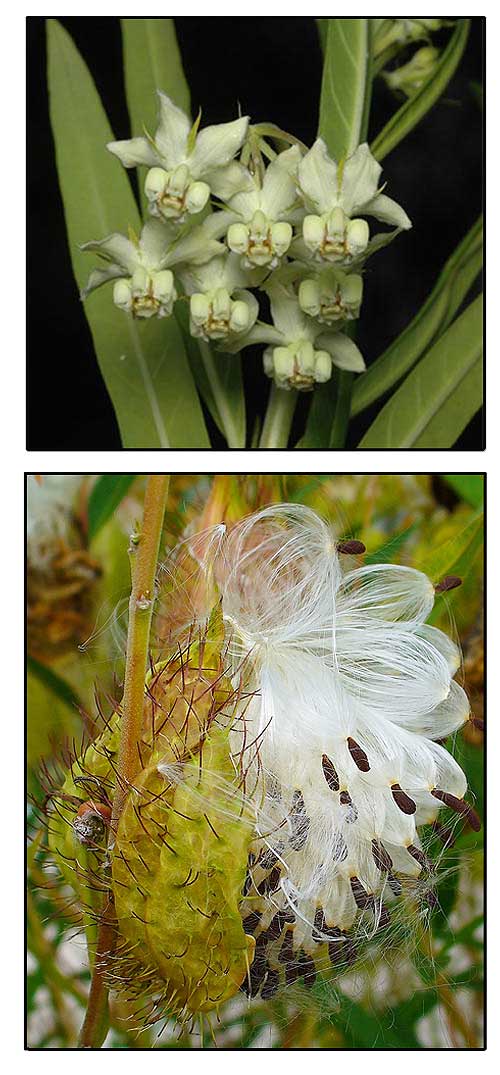
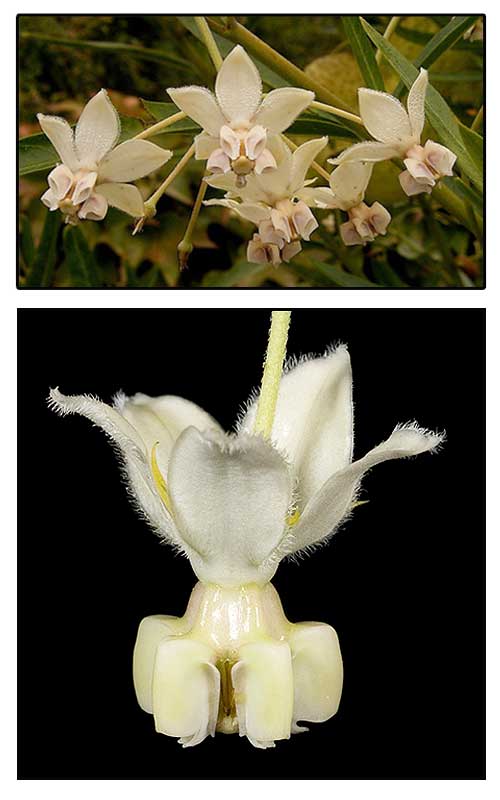
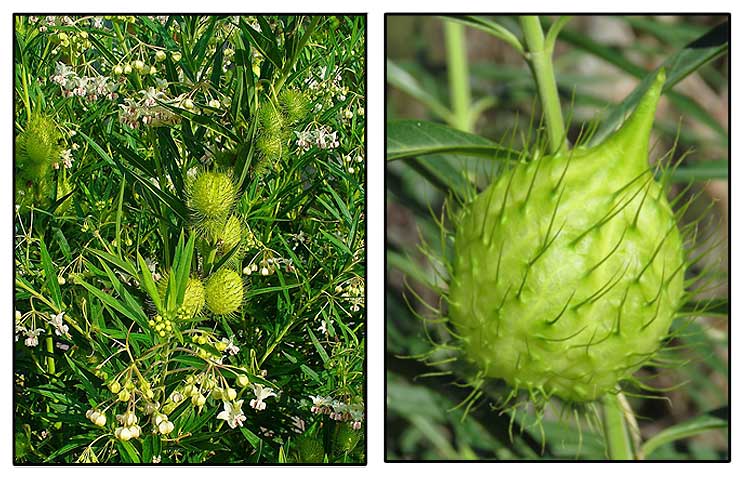
• Shrubs up to 1.5(–2.5) m tall, much branched from the base; branches erect, densely hairy when young, woody at base. Leaves opposite, short petiolate, linear to narrowly linear-elliptical, (2.5–)4–12 cm × (0.2–)0.3–0.8(–1.3) cm, entire, base cuneate, apex attenuate, yellowish-green, sparsely to densely hairy on veins. Inflorescences nodding umbel, 4–7(–12)-flowered; peduncle 1.5–3(–4) cm long; bracts filiform, deciduous; flowers 5-merous; pedicel 1–2.5 cm long; sepals lanceolate or triangular, 2–5 mm long, attenuate; corolla reflexed, white, yellowish or pink, lobes ovate, 5–8 mm × 3–5 mm, acute, margins ciliate; corona lobes attached 1–1.5 mm above base of staminal column, laterally compressed, 2–4 mm × 1.5–3 mm, as tall as the column. The fruits are follicles, ovoid, tapering into a long beak, 4–7 cm × 1.5–2.5 cm, papery, pale green, sometimes tinged reddish, short-hairy, soft spiny. (botany.cz)
• Shrub 0.6–2 m high, stems few, finely hairy when young. Leaves with lamina linear to narrow-lanceolate, 4–12 cm long, 0.5–1.5 cm wide, soft, smooth, tapering to a fine point, base attenuate; petiole 3–10 mm long. Umbels 5–10-flowered; pedicels slender, 10–20 mm long. Flowers 12–13 mm diam., pendent. Corolla lobes ovate, ciliate, 6–7 mm long. Follicles ovoid, slightly falcate, 4–6 cm long, 2–3.5 cm diam., gradually narrowed into a short, curved beak. (PlantNet)
 Distribution Distribution
- Naturalized.
(2)
- In Mindanao.
- Native to Angola, Botswana, Cape Provinces, Caprivi Strip, Djibouti, Eritrea, Eswatini, Ethiopia, Free State, Kenya, KwaZulu-Natal, Lesotho, Malawi, Mozambique, Namibia, Northern Provinces, Oman, Saudi Arabia, Somalia, Sudan-South Sudan, Uganda, Yemen, Zambia, Zimbabwe. (2)
- In grasslands, along roadsides, railway lines and fields, in disturbed sites, waste areas, on river banks, from sea level up to 2500 m.
Constituents
- Phytochemical analysis revealed presence of alkaloids, coumarins, steroids, anthraquinones, flavonoids, and triterpenoids.
GC-MS study detected beta-sitosterol, alpha-amyrin, lupeol and their esters and acetates. (7)
- Study for mineral elements composition (*% weight) yielded: carbon 61.28, oxygen 34.17, sodium 0, potassium 1.16, calcium 1.32, chlorine 0.62, sulphur 0.32, silicon 0.64, magnesium 0.38, and phosphorus 0.13. (8)
- Quantitative study of methanolic extract of leaves revealed tannins in large amounts (6.937 mg TA/g and 5.356 mg TA/g in the ethanolic extract.
(see study below) (10)
Properties
- Toxicity / Poison: Plant tissues contain a poisonous white milky latex and sufficient cardenolides, and consumption of significant quantities of leaves, stems, or fruit may lead to death in livestock and humans. (3)
- Latex causes skin irritation.
-
Studies have suggested antiurolithiatic, anticancer, antibacterial, radical scavenging properties.
-
Toxicity / Cardenolides / Implications for Therapeutic Use. (see study below) (4)
Parts used
Aerial parts, roots, leaves, leaf juice, latex.
Uses
Edibility
- Rootstock eaten as vegetable, and the fruit reportedly eaten by the Masai of Tanganyika. (Caution advised: see notes on toxicity)
Folkloric
- No reported folkloric medicinal use in the Philippines.
- In ethnomedicine, used for treatment of pain, fever, rashes. Used for treatment of urolithiasis. Roots used for treatment of chest infections, including tuberculosis. Root decoctions used for treatment of stomach aches, general body aches, and sexually transmitted diseases. (4)
- In Mauritius, leaves used for treatment of asthma, respiratory disorders, bronchitis, heart palpitations, epigastric pain, and abdominal distention. In Argentina, leaves used for treatment of tuberculosis. (4)
 - Plant also used in childhood healthcare. Infusions or poultices
from whole plant used for convulsions, stomach and chest ailments. Milky latex applied to warts. (4) - Plant also used in childhood healthcare. Infusions or poultices
from whole plant used for convulsions, stomach and chest ailments. Milky latex applied to warts. (4)
- In Ethiopia, used as ointment for treatment of sores. In Namibia, leaves brewed into tea used for treating skin cancer.
Among the Zulu of south Africa, leaf infusions used for treatment of diarrhea and stomach pains in children. In Limpopo, root decoctions used for management of infertility and stomach ailments. In Free State, root decoctions used for diabetes. In Botswana, leaf infusion used for inducing vomiting in cases of hepatitis. The Baca people incorporate leaves and latex in purgative enemas. (4)
-
The Soho community use dried stem scrapings as sternutatory (to induce sneezing) for fainting and coryza. In Zulu, plants parts (unspecified) incorporated into inembe infusions to facilitate childbirth and for treatment of stomach and body pains. (4)
- Aerial parts used as lotion to cleanse wounds and infected sores.
-
Leaves processed into snuff and emetics to strengthen the body. Particularly in the while populations, snuff from powdered leaves used for treatment of tuberculosis. The snuff also used as sedative and traditionally applied for treatment of headaches. Dried and powdered roots also used as snuff to alleviate headaches. (4)
- In Botswana, the Bayei people use root infusions for treatment of gonorrhea, the efficacy of which reportedly enhanced by combining the roots with those of Pechuel-loeschea leubnitziae. (4)
- In Uganda, roots used as emetic, diuretic, and purgative; and traditionally for treatment of asthma, bronchitis, pneumonia, stomach aches and body pains. (4)
- Freshly squeezed leaf juice diluted with water used as nasal drops to clear nasal passages and alleviate colds, especially in children. (4)
- In traditional European medicine, used for treatment of heart-related disorders.
- In Namibia, used for treatment of tumors through topical application.
Others
- Host plant: It is common in Australia and New Zealand where it is host of the monarch butterfly. (3)
- Crafts and utility: Floss from seeds used as stuffing for pillows. Spun into white cotton, used for decoration and making belts. (5)
- Fiber and fabric: Inner bark yields a strong, white bast fiber. Producible into a soft fabric, suitable for admixing with cotton. The fiber spun tint cotton used for sewing clothes. In Somalia, string used for snares and making waistbands. (5)
- Poison: Used as arrow poison. Also, as ordeal poison in judicial trials to determine guilt or innocence.
Studies
• Antiurolithiatic: Study evaluated the curative efficacy of G. fruticosus extracts in experimentally induced nephrolithiasis in male Wistar rats induced by ethylene glycol in drinking water for 28 days. Extract was administered orally in dose of 200 mg/kg for 15 to 28 days. The BuOH extract reduced the level of oxalate in the urine (p<0.001), increased the levels of magnesium (p<0.05) and citrate (p<0.01) in serum analysis after exposure to BuOH extract. In the kidneys, CaOx crystal deposits were significantly reduced by the G. fruticosus EtOAc extract (p<0.01). (6)
• Anticancer: Study evaluated a lipid-based drug delivery system based on G. fruticosus extracts, toxicity profile, its anticancer properties against three cell lines (PC3, HeLa, and HepG2),
and cytotoxicity against primary cell lines (Hck293 and KMST6). Extracts showed selective antiproliferative activity against HeLa cells (IC50 8.35 g/L), with cell death likely via necrosis rather than apoptosis. Lipid-based nanoparticles showed high encapsulation efficacy of 96.51%. Study raised the possibility that the toxicity of G. fruticosus can be managed using a lipid based delivery system especially for cervical cancer following optimization in invivo cancer disease models. Study suggests the potential for development of commercially viable, safe, and locally sourced treatment alternatives, especially for cervical cancer. (7)
• Antibacterial: Study screened 83 polar and non-polar extracts from 22 medicinal plants for antibacterial activity against Gram(+) and Gram(-) using broth microdilution method. The n-hexane and methanol extracts of Gomphocarpus fruticosus significantly inhibited the growth of Pseudomonas aeruginosa (MIC 31 µg/mL). (9)
• Antimicrobial / Radical Scavenging Activity / Leaves: Study evaluated the phytochemical content, antioxidant and antimicrobial activity of G. fruticosus leaf extracts. Antimicrobial evaluation by disk diffusion method showed ethanolic extract MIC of 1 mg./ml for S. aureus and 6 mg/ml for E. coli. On DPPH assay for radical scavenging activity, methanolic and ethanolic extracts showed IC50s of 0.25 mg/ml and 0.34 mg/ml respectively. (see constituents above) (10)
• Toxicity / Cardenolides / Implications for Therapeutic Use: The toxicity of G. fruticosus is categorized as highly hazardous, with adverse effects on the central nervous sytem, gastrointestinal system, liver and cardiovascular systems. Ingestion can result in acute poisoning. The entire plant is considred dangerous due to the presence of cardiac glycosides, which can lead to severe diarrhea, cardiac arrest, muscle weakness, spasms and seizures. Livestock poisoning have been reported. In a controlled experimental study, 40 g of fresh mixture of flowers, leaves, and stems was found lethal fto a rabbit. The plant's toxicological profile reflects the plant's narrow therapeutic index characteristic of cardiac glycosides. Cardenolides can be therapeuticallt beneficial at controlled doses, but overdosing always results in severe or fatal poisoning. The variability of cardenolide composition makes crude extracts problematic with unpredictable safety outcomes, and limits its therapeutical application. While current studies have indicate4d the leaves and roots as the most promising plant parts, particularly for anticancer, antioxidant, and antimicrobial, it is critical to refine its toxicological profile through dose-reponse evaluations, long-term safety studies and standardizations of extract to minimize overdosing risks. The integration of nanotechnology-sustained delivery systems may offer a strategy to reduce toxicity while improving bioavailability. (4)
Availability
- Wild-crafted.
- Seeds in the cybermarket.
|




_in_Serpentine_National_Park,_May_2021_06.jpg)


