HOME      •      SEARCH      •      EMAIL    •     ABOUT


Family • Putranjivaceae
Balikbikan
Drypetes longifolia (Blume) Pax & K.Hoffm.
ODOPON PUTEH

Scientific names Common names
Aporosa calocarpa Kurz ex Hook.f.           Balikbikan (Tagalog)
Cyclostemon bordenii Merr.            
Cyclostemon calocarpus Hook.f.            
Cyclostemon coruaceus Baill. ex Müll.Arg.          
Cyclostemon incarnatus Elmer         
Cyclostemon calocarpus Hook.f.            
Cyclostemon longifolius Blume          
Cyclostemon macrophyllus Blume          
Cyclostemon macrophyllus var. malaccensis Hook.f.          
Cyclostemon merrittii Elmer          
Cyclostemon zeylanicus (Thwaites) Baill.         
Drypetes bordenii (Merr.) Pax & K.Hoff.         
Drypetes calocarpa (Hook.f.) Pax & K.Hoff.         
Drypetes coriacea (Baill. ex Müll.Arg.) Pax & K.Hoff.         
Drypetes longifolia (Blume) Pax & K.Hoff.         
Drypetes macrophylla (Blume) Pax & K.Hoff.         
Drypetes myrmecophila Merr.        
Sphragidia zeylanica Thwaites  
Drypetes longifolia is an accepted species. KEW: Plants of the World Online

Other vernacular names
BORNEO: Kikr daun besar, Maklawi, Mintulang.
INDONESIAN: Ki sa'at, Buniyaga, Batung, Kikir daun besar.
MALAYSIAN: Opodon putih.
THAI: Khao phota luang kaeo, Khao thalu, Khlong nang yon (Ranong), Ko surin (Phangnga), Khao luang (Nakhon si thammarat).


Gen info
- Putranjvaceae is a rosid family composed of 218 species in 2 genera of evergreen tropical tress that are found in the Old World tropics, with a few species in tropical America. The family was formerly a tribe (Drypeteae) of the subfamily Phyllanthoideae in the Euphorbiaceae.
- Drypetes is a genus of plants in the family Putranjivaceae. It was previously place in the family Euphorbiaceae. The genus Drypetes comprises about 200 species of dioecious tress or shrubs. (3)

- Etymology: The genus Drypetes probably derives from Greek drypa, meaning dried olive or drupe, alluding to the stone-containing fruit. The specific epithet longifolia derives from Latin, meaning "long leaves," referring to the plant's large and elongated foliage.

Botany
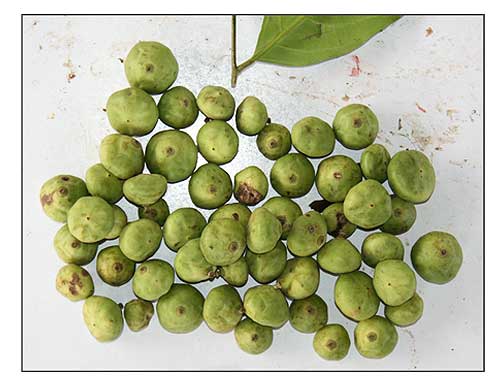
• A mid-canopy tree up to 32 m tall and 76 cm dbh. Twigs hollow and inhabited by ants. Leaves alternate, simple, penni-veined, strongly unequal leaf base, glabrous, large. Flowers ca. 8 mm diameter, whitish, placed in axillary bundles. Fruits ca. 26 mm long, orange-reddish, cauliflorous, fleshy drupes. (2)

• Tree, ± 15 m high; branches yellowish-brown pubescent, glabrescent. Leaves: petiole 7–12 mm long; blade oblong to elliptic, 14–24 by 4–6 cm, coriaceous, base unequally cuneate or rounded, margin entire, apex obtusely acuminate, subglabrous; nerves 8–10 pairs, prominent beneath. Flowers ramiflorous on tubercles of older twigs and branches. Staminate flowers: pedicel 6–11 mm long, brown velutinous; sepals 4 or 5, semiorbicular, 5–8 by 5–8 mm, spreading patently, velutinous outside, margin shortly ciliate; stamens numerous; disc hairy. Pistillate flowers: pedicel 5–7 mm long, short-hairy; sepals ovate-orbicular, 3–4 by 3–4 mm, outside densely short-hairy, margin short-ciliate; disc annular; ovary globose, 2 locular, densely short-hairy; stigmas large, transversely oblong or obtriangular, sessile. Fruits subglobose, up to 4 cm in diam., sulcate, pubescent; exocarp crustaceous, mesocarp spongy, endocarp hard. (Flora of Thailand)

Distribution
- Native to the Philippines.
- In primary forests at low elevation.
- Also native to Andaman Is., Borneo, India, Jawa, Lesser Sunda Is., Malaya, New Guinea, Nicobar Is., Sri Lanka, Sulawesi, Sumatera, Thailand. (1)
- A mid-canopy tree in undisturbed mixed dipterocarp forests up to 600 m altitude. On alluvial (river sides) and dry (hillsides and rides) sites with sandy soils. Also found on limestone. In secondary forests usually as pre-disturbance remnant tree.  (2)

Constituents
- No phytochemical studies specific for Drypetes longifolia found.
- Glucosinolates are reported to be abundant in the Genus Drypetes.

Properties
- Ecology: The plant is defended by stinging ants (that live symbiotically in the hollow twigs of the plant.

Parts used
Stems, leaves.

Uses

Edibility
- Fruits are edible, sweet when ripe and eaten raw.
Folkloric
- No reported folkloric medicinal use in the Philippines.
- In Indonesia, decoction of stem and leaves drunk as tonic after pregnancy. (4)
Others
- Wood: Wood is exceptionally tough. Used for general construction, beams, joists, rafters, flooring; furniture and cabinet making, rice mortars, tool handles, piles, poles, and railway sleepers. (5)

- Fiber: Provides fibers in length of 2-2.7mm; in mixtures, use for making paper.

Studies
• No studies found.

• While no studies focus exclusively on D. longifolia, its therapeutic potential may be appreciated via studies of other species in the genus. Plants in the genus Drypetes (Putranjivaceae) are used in Subsaharan African and Asian traditional medicines for a spectrum of diseases, such as dysentery, gonorrhea, malaria, rheumatism tumors, wound healing, headaches, typhoid, among others. Some species are used as aphrodisiac, insect repellent, rodentocide, fish poison, etc.

Availability
Wild-crafted.

Updated September 2026
February 2024

                                                 PHOTOS / ILLUSTRATIONS
IMAGE SOURCE: Putranjivaceae : Drypetes longifolia / Leaves / Copyright © 2011 by Leonardo L Co [ref. DOL26718] / Non-Commercial Use / Image modified / Click on image or link to go to source page / Phytoimages.siu.edu
IMAGE SOURCE: Putranjivaceae : Drypetes longifolia / Close-up of developing fruits / CC BY NC-ND / Martin W Callmander / Image modified / Click on image or link to go to source page / Useful Tropical Plants
IMAGE SOURCE: Putranjivaceae : Drypetes longifolia tree / CC BY-SA 3.0 Unported / R Rahasia / Image modified / Click on image or link to go to source page / Wikimedia Commons
IMAGE SOURCE: Drypetes longifolia fruits / Obseerver: R Ctvrtecka / Image modified / Drypetes longifolia tree / Public Domain / Click on image or link to go to source page / bellstlas.umn.edu

Additional Sources and Suggested Readings
(1)
Drypetes longifolia / KEW: Plants of the World Online
(2)

Drypetes longifolia / AsianPlantNet
(3)
Drypetes / iNaturalistNZ
(4)
Diversity of Indonesian Medicinal Plant in The lowland Forest, Bodogol and Its Surrounding of Mount GedePangrango National Park, West Java / S Susuartum N, M Rahayu, Rugayah / IOP Conf Series: Earth and Environmental Science, 2018; 166: 012021 / DOI: 10.1088/1755-1315/166/1/012021
(5)
Species richness, conservation status, and potential uses of plants in Segara Anakan Area of Sempu Island, East Java, Indonesia / Siti Nurgadilah et al / BIODIVERSITAS, 2017; 18(4): pp 1568-1588 /
pISSN: 1412-033X / pISSN: 2085-4722
(6)
S containing bioactive cancer preventive compounds in almost all major genera and in every class of primary and secondary metabolites of Euphorbiaceae. / Ashwani Kumar / Science 2.0
(7)
Phytochemistry and pharmacology of the genus Drypetes: A review / Jean Duplex Wansi, Jean Wandji et al / J Ethnopharmacol. 2016; 190: pp 328-353 / DOI: 10.1016/j.jep.2016.06.060
(9)
Putranjivaceae / Wikipedia

•

DOI: It is not uncommon for links on studies/sources to change. Copying and pasting the information on the search window or using the DOI (if available) will often redirect to the new link page. (Citing and Using a (DOI) Digital Object Identifier)

                                                            List of Understudied Philippine Medicinal Plants
                                          New plant names needed
The compilation now numbers over 1,750 medicinal plants. While I believe there are hundreds more that can be added to the collection, they are becoming more difficult to find. If you have a plant to suggest for inclusion, native, introduced, cultivated or naturalized, please email the info: scientific name (most helpful), local plant name (if known), any known folkloric medicinal use, and, if available, a photo. Also, if you run into a plant that needs updating, please ket me know. Cheers. Dr. Stuart
•

•
HOME      •      SEARCH      •      EMAIL    •     ABOUT