HOME      •      SEARCH      •      EMAIL    •     ABOUT


Family Zingiberaceae
Bagumbung
Tagbak-baba
e / Tayabak-babae
Alpinia haenkei C.Presl
YANGUAS

Scientific names Common names
Alpinia haenkei C.Presl. Bagumbung (Tag.)
Alpinia malaccensis C.Presl Banay-banay (Nueva Viscaya)
Alpinia philippinensis Ridl. Barapat (Ig.)
Catimblum haenkei (C.Presl) M.L.Steiner Birao-birao (Sul.)
Languas haenkei (C.Presl) Merr. Kalaueg (Ig.)
  Panoon (Manobo)
  Punan (C. Bis.)
  Sigiapag (Neg.)
  Simionan (Buk.)
  Tagbak-babae (Tag.)
  Tagbak-lalaki (Tag.)
  Tagbak-na-pula (Tag.)
  Tagusahis (P. Bis.)
  Talbak (Tag.)
  Tamo-tamo (Sbl.)
  Tayabak-gabae (Tag.)
  Tukang-maya (Tag.)
  Yanguas (Agusan del Sur)
Alpinia haenkei C. Presl is an accepted species. KEW: Plants of the World Online
Note: There is confusing info on distribution, synonyms, and common names. Co's database lists it as endemic. POWO lists presence in Jawa. Quisumbing notes its presence in Borneo. The Philippine Traditional Knowledge Digital Library adds additional common names.
Note: Page revised February 2026. The previous page included information for Alpina haenkei and Alpinia malaccensis (Burm.f.) Roscoe as synonym, along with its images; instead of Alpinia malaccensis C.Presl.


Gen info
- Alpinia is a genus of flowering plants in the ginger family, Zingiberaceae. Species are native to Asia, Australia, and the Pacific Islands, occurring in tropical and subtropical climates. Some are cultivated as ornamental plants. Species in the genus are generally known as shell gingers.
- It is the largest genus in the ginger family, POWO listing 249 species and 2 hybrids (June 2025).
- Taxonomy / Etymology: The genus was erected by Scottish botanist William Roxburgh in 1810, the name honoring Prospero Alpini, a 17th-century Italian botanist who specialized in exotic plants. (1)

Botany
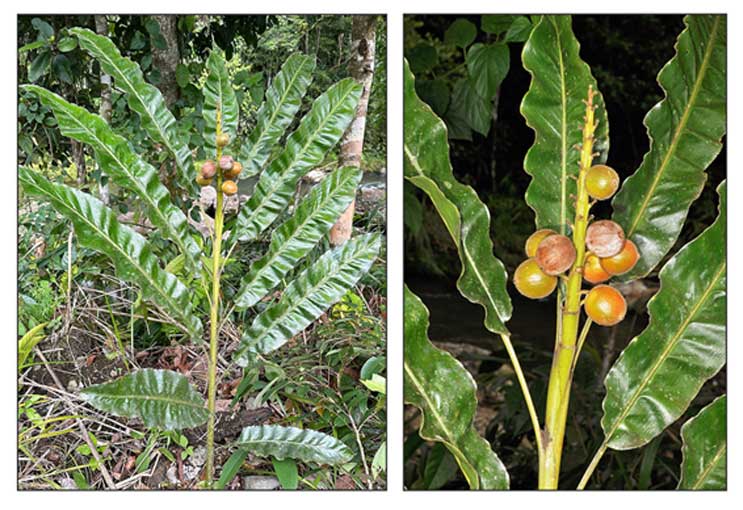
• Tagbak-babae is a herbaceous plant growing to about 2 meters tall. Leaves are oblong, 30 to 60 centimeters long, 10 to 13 centimeters wide, smooth on both surfaces except on the edges and at the base where it is hairy. Bracts are large spathaceous, about 2 centimeters long. Calyx is spathaceous, urn-shaped, cleft on one side, irregularly toothed, and as long as the corolla tube, 10 to 13 millimeters long. Corolla tube is broad, with the lobes, white, silky, broad, oblong, about 2 centimeters in length and 7 millimeters wide. Lip is about 3 centimeters long, broad, and yellow with purple spots.
(Quisumbing)

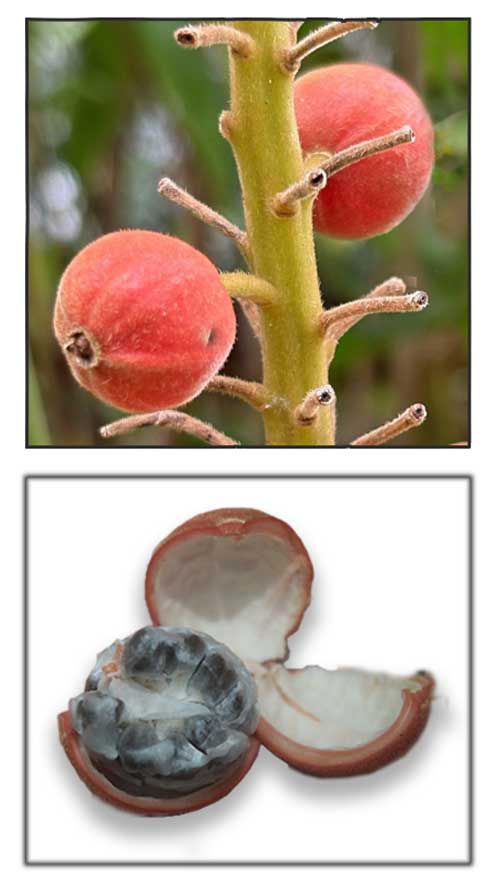
• Terrestrial herbaceous plant that grows up to 2 m tall. Rhizome reddish, creeping, 5 to 10 cm in diameter. Leaf distichous, broadly lanceolate, 65 to 67 cm long by 10-11 cm wide. Margin entire to wavy with fine hairs. Leaves adaxially and abaxially pubescent, base oblique, apex broadly acuminate, petiole 4 to 6 cm long, ligule bifid, oblong shaped per lobed, reddish, 2.2 cm long. Inflorescence terminal, racemose, 20-35 cm long, racemous. Fruit round to oblong, 2 to 3 cm long by 0.5 to 1 cm in diameter, pubescent all throughout. Green when immature and red when ripe. (20)

Distribution
- Native, endemic. (3)
- Common in primary forests at low and medium altitudes throughout the Philippines. Batanes and Luzon to Mindanao, in most or all islands and provinces. Often common in primary forests,
0-1900 m. (3)
- Also native to Jawa (Indonesia). (2)
- Conflicts: There is confusing information on distribution. Co's database lists it as endemic, adding that it was mistakenly recorded for Java by Newman et al. (2004) according to Rudolph Docot (pers. comm. 14-Jan-21). POWO lists presence in Jawa. Quisumbing notes its presence in Borneo.

Constituents
- Phytochemical screening of leaf extract yielded alkaloids, flavonoids, steroids, carbohydrates, tannins, saponins, and glycosides.

Parts used
Leaves, bark, fruit.

Uses

Edibility
- Fruits and seeds reportedly edible.
Folkloric
- The Manobo in Agusan del Sur drink decoction of roots for cough, stomach ache, difficulty in urination, and urinary tract infections. (16) Fruits used for treatment of fever. (18)
- In the Alabat Island, Tagbak-na-pula stems used for snake bite. Also used by local healers to counter "barang" (a sorcery-induced illness cause by the insect Alphitobius laevigatus). In Zamboanga, stems of Tagbak-babae used for treatment of swollen muscles.
- In Nueva Viscaya, banay-banay roots used for toothaches. In Oriental Mindoro, the Hanunuo Mangyan tribe use leaves, bark, or fruit for treatment of asthma.   (17)
- Decoction of fruit or crushed seeds used in cases of gastralgia with tympanitis.
- Decoction also used as puerperal bath and for fevers.
- Crushed rhizomes taken for gas pains.

Other
- Agrofrestry:
Leaves sometimes used in agrisilviculture, for rice virus (tungro) control.

Studies
No studies found.
Note:
Studies on previous page erroneously posted studies belonging to Alpinia malaccensis (Burm.f.) instead of Alpinia malaccensis C.Presl.

Availability
- Wild-crafted.
- Ornamental cultivation.

© Godofredo U. Stuart Jr., M.D.

Updated February 2026 / November 2017 / April 2013

PHOTOS / ILLUSTRATIONS
IMAGE SOURCE: Alpinia haenkei (3 images) / © Pieter Pelser / Alpinia haenkei from Bukidnon / Images modified / Non-commercial use / / Click on image or link to go to source page / Pieter Pelser Post / Facebook / Philippine Plants
OTHER IMAGE SOURCE: Alpinia haenkei - Opened fruit / © Paul A C Ondoy / CC BY-NC 4.0 / Image modified / Click on image or link to go to source page / Wikipedia
OTHER IMAGE SOURCE: Alpinia haenkei - ripe fruits / © Ethan Hernandez / Non-commercial use / Image modified / Click on image or link to go to source page / Facebook: JOHernandez Post

Additional Sources and Suggested Readings
(1)
Alpinia / Wikipedia
(2)
Alpinia haenkei / KEW: Plants of the World Online
(3)
Alpinia haenkei / Co's Digital Flora of the Philippines
(7)
Cross-cultural studies of important ethno-medicinal plants among four ethnic groups of Arunachal Pradesh, Northeast India /Japi Siram, Nagaraj Hegde, Kumar Sahoo et al / Ethnobotany Research and Applications, 2023; 25(12): pp 1-23 / DOI: 10.32859/era.25.12.1-23
Alpinia haenkei /
KEW: Plants of the World Online
(16)
Quantitative ethnopharmacological documentation and molecular confirmation of medicinal plants used by the Manobo tribe of Agusan del Sur, Philippines / Mark Lloyd G. Dapar, Grecebio Jonathan D. Alejandro, Ulrich Meve and Sigrid Liede-Schuma / Journal of Ethnobiology and Ethnomedicine, 2020; 16:14 /
DOI: 10.1186/s13002-020-00363-7
(17)
Alpinia haenkei / Philippine Traditional Knowledge Digital Library of Health
(18)
Ethnopharmacological documentation and molecular authentication of medicinal plants used by the Manobo and Mamanwa tribes of Surigao del Sur, Philippines / Vince Adrian D Ilagan, Grecebio Jonathan D Alejandro, David Jefferson B Paraguison et al / BIODIVERSITAS, 2022; 23(6): pp 3185-3203 /
ISSN:1412-033X / eISSN: 2085-4722 / DOI: 10.13057/biodiv/d230646
(20)
Zingiberaceae of Kalatungan Mountain Range, Bukidnon, Philippines
/ Mark Arcebal K Naïve / Bioscience Discovery, 2017; 8(3): pp 311-319 / pISSN: 2229-3469 / eISSN: 2231-024X

It is not uncommon for links on studies/sources to change. Copying and pasting the information on the search window or using the DOI (if available) will often redirect to the new link page.

DOI: It is not uncommon for links on studies/sources to change. Copying and pasting the information on the search window or using the DOI (if available) will often redirect to the new link page. (Citing and Using a (DOI) Digital Object Identifier)

                                                            List of Understudied Philippine Medicinal Plants
                                          New plant names needed
The compilation now numbers over 1,720 medicinal plants. While I believe there are hundreds more that can be added to the collection, they are becoming more difficult to find. If you have a plant to suggest for inclusion, native or introduced, please email the info: scientific name (most helpful), local plant name (if known), any known folkloric medicinal use, and, if possible, a photo. Your help will be greatly appreciated.

HOME      •      SEARCH      •      EMAIL    •     ABOUT