HOME    •    SEARCH      •      EMAIL    •     ABOUT  •     DONATE


Family • Fabaceae
Alibangbang-puti
Phanera semibifida (Roxb.) Benth.
BUTTERFLY CLIMBER / WHITE BAUHINIA

Scientific names Common names
Bauhinia semibifida Roxb. Alibangbang puti (Tag.)
Bauhinia semibifida (Roxb. ) Benth. Alibangbang tapol (Tag.)
Accepted infraspecifics (6) Butterfly climber (Engl.)
P. semibifida var. acuminata (K & SS Larsen) Bandyop et al Butterfly root plant (Engl.)
P. semibifida var. bruneiana (K & SS Larsen) Bandyop et al Trailing bauhinia (Engl.
P. semibifida var. longebracteata (K & SS Larsen) Bandyop et al White bauhinia (Engl.)
P. semibifida var. pekinsiae (Merr.) Bandyop, Ghoshal& Pathak  
P. semibifida var. semibifida  
Bauhinia borneensis Merr.  
Phanera sumatrana Miq.  
P. semibifida var. stenostachya (Baker) de Wit  
Bauhinia semibifida var. stenostachya (Baker) K & SS Larsen  
Phanera semibifida is an accepted species. KEW: Plants of the World Online

Other vernacular names
BORNEO: Kaba.
INDONESIA: Kupu (Kalimantan); Ganggang katup (Lingga); Khaka kaia (Seram.)
MALAYSIA & SUMATRA: Akar kati katwi, Takui lebang, Akar tempela, Daun bedaub, Daup-daup.
OTHERS: Andor si bola, Andor sibola ringring.

Gen info
- Fabaceae or Leguminosae, commonly known as the legume pea, or bean family, is a large and agriculturally important family of flowering plants that includes trees, shrubs, and perennial or annual herbaceous plants, which are easily recognized by their fruit (legume) and their compound, stipulate leaves. It is widely distributed and is the third largest land plant family, behind only Orchidaceae and Asteraceae, with about 765 genera and nearly 20,000 known species. (4)
- Phanera is a genus of flowering plants in the legume subfamily Cercidoideae and the tribe Bauhinieae.
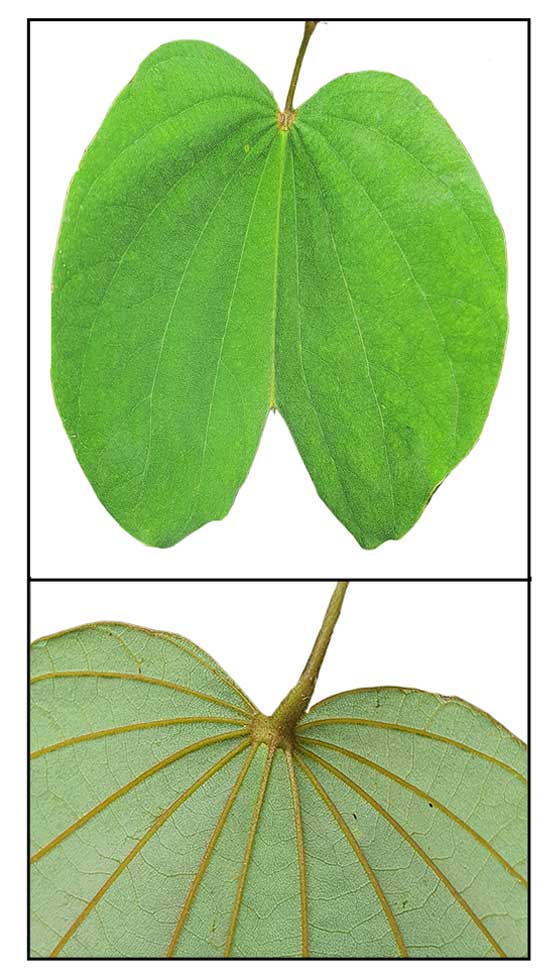
- Etymology: The genus name Bauhinia honors the prominent 16th-century Swiss botanists and siblings John and Caspar, where the twin leaf-lobes of the genus are said to symbolize the two brothers. The specific epithet semibifida derives from semi and bifida, referring to the twin-lobed foliage. (5) The genus name Phanera derives from Ancient Greek word phaneros, which means conspicuous, visible, or manifest.

Botany
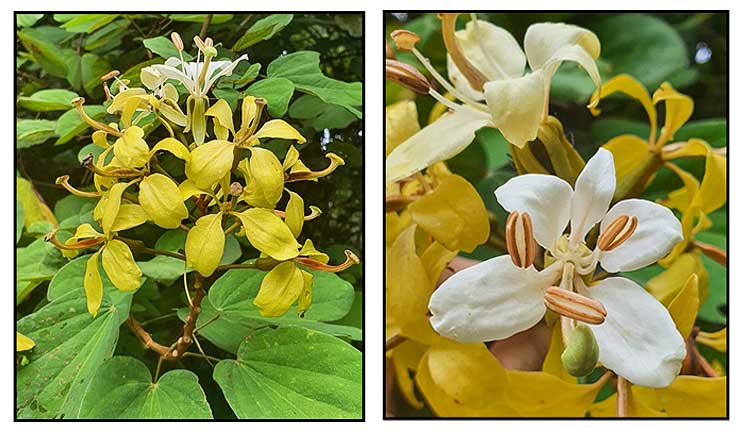
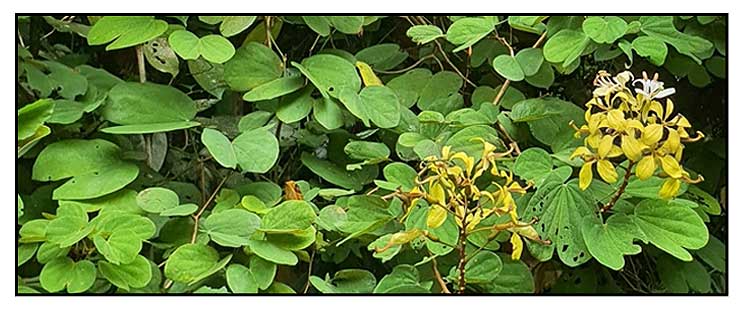
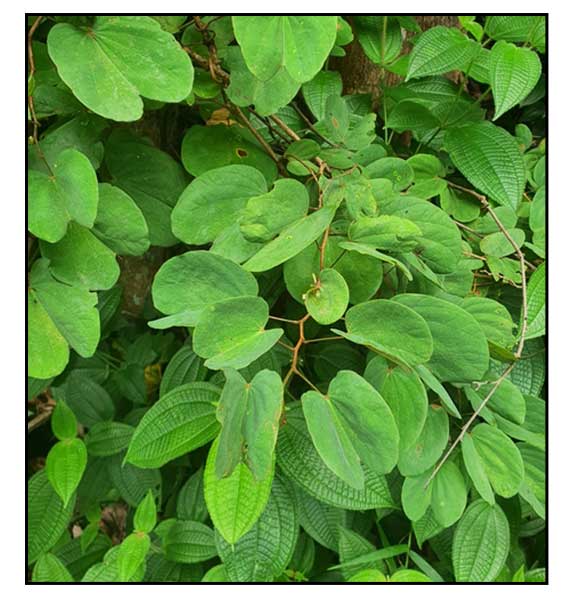
• A scandent shrub or liana with a few tendrils, young branches brownish pubescent; leaves obovate-orbicular, 4—11 cm x 4—11 cm, bifid up to 1/4—2/5, base cordate, apex of lobes obtuse to acute, stipules auriculate or orbicular up to 5 mm x 2 mm; inflorescence a terminal or lateral raceme; flower buds club-shaped, 1—2.5 cm long, pubescent, hypanthium tubular, dilated at base, calyx early splitting into 5 reflexed, strap-shaped sepals, petals elliptical to oblong, unequal, 2—3(—3.5) cm long, claws 0.2—0.5 cm long, white turning yellow, fertile stamens 3, staminodes 2—3; fruit strap-shaped, 10—20 cm x 3—4 cm, beak 0.5—1 cm, glabrous, c. 6-seeded; seeds flat, varying in sizE. (3)

• Growth form: A woody twinning climber. Foliage: Leaves butterfly-shaped, green and glabrous above, silver below with fine brownish-orange hairs on base and along veins, giving leaves a golden sheen. Young leaves orangey and folded, extended by a pair of velvety stipules before emerging. Stems: Densely covered by fine fuzz of orange hairs. Flowers: Start out white and age to yellow, fragrant, produced on terminal, elongated erect racemes. Flower buds mature from fairly glabrous white to pubescent golden brown, opening sequentially from bottom to top. Plant rarely blooms, but flowers are long-lasting (at least a few weeks). Locally, flowers appear to require hand pollination to produce fruits. Fruit: Fruits are golden brown, woody explosive seed pods with distinct drip-tip, ripening from green to brown in around 1 month after pollination. (Flora & Fauna Web)

Distribution
- Native to the Philippines. (1)
- In Cebu, Mindoro, Palawan,Sibuyan; in Mindanao: Zamboanga del Norte.
- In forest margins at 100-2000 m. altitude.
-
Also native to Borneo, Malaya, Myanmar, Sulawesi, Sumatera. (1)

Constituents
- LC-MS/MS analysis of leaf and stems extracted with 96% ethanol using maceration method identified 26 compounds from the stem extract and 24 from the leaf extract. The compounds belonged to seven compound groups: carboxylic acid, flavonoic, phenolics, polifenol, terpenoid, tricarboxylic acid, and Humulonoid. Isolated compounds differed: Quercetin-3'-glucuronide, apigetrin, and glucogallin are found only in stems, while salicylic acid is only found in the leaf extract. (see study below) (7)
- Study of leaves and stem extracts yielded four compounds that were selected for molecular docking studies: Estrogen receptor-α, CDK2, human cytochrome P450 CYP17A1, Cyclin A, and BCL-2. (see study below) (8)
- Crude extract of stems yielded alkaloids, triterpenoids, steroids, flavonoids, and phenolics; n-hexane fraction yielded triterpenoids and steroids; ethyl acetate fraction yielded alkaloids, triterpenoids, steroids, flavonoids, and phenolics; while an aqueous fraction reveaed alkaloids, flavonoids, and phenolics. (see study below) (9)

Properties
- Studies have suggested antioxidant, cytotoxicity, anticancer, anti-inflammatory properties.

Parts used
Roots, leaves.

Uses

Edibility
- While roots and stems have been used traditionally in health potions, the plant is not used as food source.
Folkloric
- No reported folkloric medicinal use in the Philippines.
- In the Lingga Islands (Indonesia), roots pounded in water are used to treat venereal diseases. In Central Seram, stem decoction used for treatment of diarrhea. Leaves are applied on skin to reduce swellings and bruises.   (3)
- Root infusion used for treatment of fatigue.
- Lingga Malay ethnic use stems as main ingredient in health potions.


Studies
• Antioxidant / Leaves and Stems:
Study evaluated stem and leaf extracts for antioxidant potential by DPPH methods. The stem extract showed highest activity with IC50 of 9.091 ppm. The antioxidant activity was attributed to higher flavonoid contents. (see constituents above) (7)
• Anticancer / Brine Shrimp Lethality and Molecular Docking / Leaves and Stems: Study evaluated extracts of stems and leaves for cytotoxic activity. The ethanolic stem extract showed highest LC50 in moderate toxicity category. Four compounds were selected for molecular docking studies: Estrogen receptor-α, CDK2, human cytochrome P450 CYP17A1, Cyclin A, and BCL-2. Results showed ellagic acid bound strongly to estrogen receptor-α, CDK2, CYP17A1, and Cyclin A protein. Cyanidanol showed highest affinity to BCL-2. Results suggest the P. semibifida contains compounds that can target multiple cancer-related proteins. Study suggests further testing of their efficacy via in vitro and in vivo studies to confirm therapeutic potential. (8)
• Anti-Inflammatory / Cytotoxicity / Stem: Study evaluated stem extracts for phytochemical screening, toxicity by Brine Shrimp Lethality Test (BSLT), and anti-inflammatory activity by protein denaturation inhibition. Toxicity levels (LC50s) of crude extract, n-hexane fraction, ethyl acetate Fx, and aqueous Fx were 57.45, 158.04, 42.34, and 72.88 µg/mL, respectively, indicating toxic activity against Artemia salina L. larvae. Anti-inflammatory activity levels (IC50s) were 124.95 (moderate), 161.27 (moderate), 99.15 (strong) and 143.44 µg/mL (moderate), respectively. Results suggests bioactive compounds and potential as a natural anti-inflammatory agent. (see constituents above) (9)

Availability
- Wild-crafted.

November 2026

                                                 PHOTOS / ILLUSTRATIONS
IMAGE SOURCE: Phanera semibifida / © pbsg (plantbrosg) / Some rights reserved / CC BY 4.0 International / Image modified / Click on image or link to go to source page / iNaturalist
IMAGE SOURCE: Phanera semibifida / © pbsg (plantbrosg) / Some rights reserved / CC BY 4.0 International / Image modified / Click on image or link to go to source page / 6 images for this page all by pbsg / /iNaturalist
 

Additional Sources and Suggested Readings
(1)
Fabaceae: Phanera semibifida / Co's Digital Flora Database
(2)
Phanera semibifida /
KEW: Plants of the World Online
(3)
Phanera semibifida / JWA Ridder-Numan / PROSEA: Plant Resources of South-East Asia
(4)
Fabaceae / Wikipedia
(5)
Phanera semibifida / National Parks: FLORA & FAUNA WEB
(6)
Phanera / Wikipepdia
(7)
Phytochemical Analysis and antioxidant activity from Phanera semibifida stem and leaves extracts using LC-MS/MS / Meyla Suhendra, Berry Juliandi, Huda Shalahudin Darusman, Siti Sadiah, Fitmawati, Sri Budiarti, Puji Rianti / Biodiversitas Journal of Biological Diversity, 2025; 26(1) /
DOI: 10.13057/biodiv/d260149
(8)
Anticancer Activity of Phanera semibifida Extract Evaluated by Brine Shrimp Lethality Test (BSLT) and Molecular Docking Studies / Meyla Suhendra, Berry Juliandi, Huda Shalahudi8n Darusman,, Siti Sadiah, Fitmawati Fitmawati, Puji Rianti / JHNR: Journal of Health and Nutrition Research, 2026; 5(1) /
DOI: 10.56303/jhnresearch.v5i1.850 / eISSN: 2829-9760
(9)
Pharmacological Potential of the Stem of Butterfly Root Plant (Phanera semibifida Roxb. var. semibifida): A Phytochemical, Toxicity, and Anti-Inflammatory Activity Study / Ayu Mellyanti, Rita Hairani, Erwin Erwin, Winni Astuti, Medi Hendra et al / OiPub
(10)
The Potential oOf Butterfly Root Plant (Phanera semibifida Roxb. var. semibifida) Stem as a Source of Antioxidants and Natural Sunscreen Agent / Nurnaningsi T, Rita Hairani, Chairul Saleh et al / Jurnal Kimia, 2025; 23(1) / DOI: 10.30872/jkm.v23i1.1559

•

DOI: It is not uncommon for links on studies/sources to change. Copying and pasting the information on the search window or using the DOI (if available) will often redirect to the new link page. (Citing and Using a (DOI) Digital Object Identifier)

                                                            List of Understudied Philippine Medicinal Plants
                                          New plant names needed
The compilation now numbers over 1,830 medicinal plants. While I believe there are hundreds more that can be added to the collection, they are becoming more difficult to find. If you have a plant to suggest for inclusion, native or introduced, please email the info: scientific name (most helpful), local plant name (if known), any known folkloric medicinal use, and, if possible, a photo. Your help will be greatly appreciated.
•

•
HOME      •      SEARCH      •      EMAIL    •     ABOUT