 Gen info Gen info
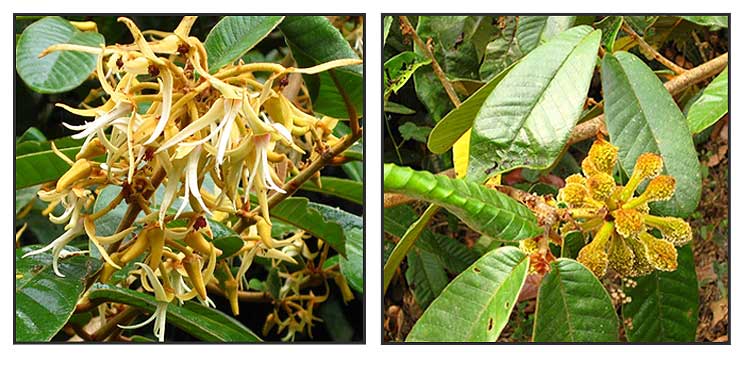
- Fisistigma is a genus of flowering plants in the family Annonaceae. It is distributed in Africa, Asia, and Oceania. As of 2025, POWO lists 59 species. (3)
 Botany Botany
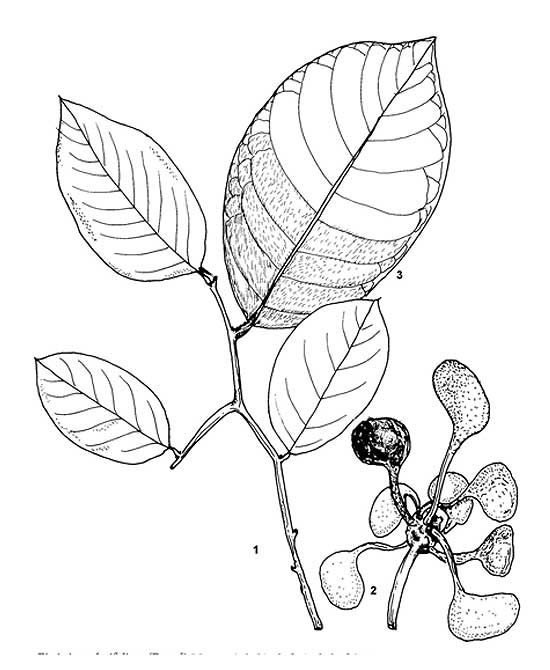
• Climbers to 5 m tall. Branches tawny pubescent when young, glabrescent. Petiole 1-1.5 cm, robust, abaxially grooved, tawny pubescent; leaf blade oblong, oblong-elliptic, or obovate, 13-35 × 5-15 cm, papery, abaxially tawny pubescent and more densely so on veins, adaxially puberulent, secondary veins 18-22 on each side of midvein, at ca. 45° to midvein, anastomosing before margin, and adaxially impressed, reticulate veins dense and nearly at 90° to secondary veins, base rounded, apex acute. Inflorescences leaf-opposed, panicles borne on apical branches, to 20 cm, densely tawny pubescent; peduncle 1.5-1.8 cm; bracts broadly ovate, 3-4 × 3-4 mm, abaxially densely tawny pubescent. Pedicel ca. 2 cm, bracteolate at middle. Flower buds ovoid, recurved. Sepals broadly ovate, 5-6 × 5-6 mm, outside densely tawny pubescent. Outer petals outside reddish and basally orange, inside orangish red, ovate, 1.6-2.2 × 1.1-1.5 cm, thickened, outside brown pubescent, inside glabrous; inner petals ovate, 1.2-1.5 × 0.6-0.8 cm, glabrous. Stamens oblong, ca. 2.5 mm; connectives ovoid, apex obtuse. Carpels oblong, densely villous; ovules 8 per carpel; stigmas pubescent. Monocarp stipes ca. 3 cm, pubescent; monocarps globose, ca. 2 cm in diam., densely brown pubescent. Seeds 4-8 per monocarp.
(Flora of China)
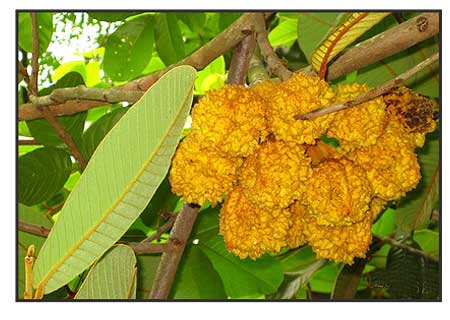
• Fissistigma latifolium is a large, climbing shrub with large leaves, 15.23 cm long and 7-11 cm wide. The panicles are opposite the leaves at the branch tips. The flower buds are ovate and curved downwards, with creamy-white petals 5-6 cm long. The fruit is spherical, about 2 cm in diameter, densely covered with short, yellowish-brown hairs. Flowering occurs from February to April, and fruiting from May to July. (Chinese Academy of Sciences)
• A large liana can grow up to measure 20 m long. Leaves are oblong, obovate or oblong-lance-shaped and with a size of measuring 8-35 cm x 3.5-15 cm. The rusty brown hairy leaves are with distinct tertiary venation below. The outer orange petals are measure 1-3 cm long. Monocarp is oblong or nearly spherical in shape, measuring about 2-5 cm long and with stalk that up to measure 4 cm long.
Distribution
- Native to the Philippines. (1) (2)
- In forests at low and medium elevations. (2)
- In
Luzon: Albay, Bataan, Camarines Norte, Camarines Sur, Catanduanes, Isabela, Laguna, Quezon, Rizal, Sorsogon, Zambales; in Mindanao: Davao del Sur, Lanao del Sur, Zamboanga. (f)
- Also native to Borneo, China South-Central, Jawa, Malaya, Maluku, Sulawesi, Sumatera, Vietnam. (1)
 Constituents Constituents
- Phytochemical screening of leaves yielded steroidal glycoside, tannins, flavonoids, saponins, alkaloids, and terpenoids. Preferred extraction solven was hydroalcoholic, with maximum extraction yield of 52.27%.
(3)
- Study of bark of F. latifolium yielded a new aporphine alkaloid, (-)-N-methylguattescidine (1), and eight known alkaloids: liriodenine (2), oxoxylopine (3), (-)-asimilobine (4), dimethyltryptamine (5), (-)-remerine (6), (-)-anonaine (7), columbamine (8) and lysicamine (9). (4)
- Study of methanolic extract of Fissistigma latifolium isolated two new compounds: 2,5,6,7-tetra-methoxyflavan (1) and 2′-hydroxy-4′,5′,6′-trimethoxybenzil (2).
(see study below) (5)
- Study of methanolic extract isolated two novel chalconoids, [3–3′′]bi-2-hydroxy-4,5,6-trimethoxy-dihydrochalcone (1) and 4,6-dimethoxy-2,5-quinodihydrochalcone (2) and 12 compounds.
(see study below) ( 6)
- Bioassay-guided purification isolated four new compounds from stem bark of Fissistigma latifolium: (+)- and (−)-ecarlottone (1), (±)-fislatifolione (5), (±)-isofislatifolione (6), and (±)-fislatifolic acid (7), and the known desmethoxyyangonin (2), didymocarpin-A (3), and dehydrodidy-mocarpin-A (4).
(see study below) (8)
- Study of leaf oil composition of Fissistigma latifolia yielded major components of ( E )- α -bergamotene (52.0%), (E)- β -caryophyllene (9.0%) and β -bisabolene (6.0%).
Properties
- Studies have suggested antibacterial, antioxidant, cytotoxicity, anti-inflammatory, anticancer properties.
Parts used
Bark, roots.
Uses
Edibility
- Fruit is reported as non-edible.
Folkloric
- Subanen of Lapuyan, Zamboanga del Sur drink root decoction as anticancer medicine. (9)
- In Malaysian folk medicine, use as treatment for postpartum mothers.
Studies
• Alkaloids / Antioxidant / Cytotoxicity / Antibacterial: Study of bark Study for isolation 9 alkaloids: liriodenine, oxoxylophine, asimilobine, dimethyltryptamine, N-methylanonaine, anonaine, columbamine, lysicamine and alkaloid FL7. Crude extracts and selected alkaloids were screened for antioxidant activity. The methanol extract showed highest % inhibition while asimilobine showed strongest antioxidant activity by FTC and TBA assays. By DPPH assay, the petroleum ether extract showed good radical scavenging with % inhibitionn of 86.4%. On cytotoxicity evaluation, liriodenine was strongly cytotoxic towards WEHI, HLGO, and CEMSS cell lines with COso values less than 23.0 µg/ml, while oxoxylophine showed weak cytotoxicity towards WEHI with CDso 27.4 µg/ml. On antimicrobial assay, anonaine showed moderate activities against Bacillus subtilis, Enterococcus faecalis, Staphylococcus aureus, S. epidermis, and Streptococcus pneumonia. (4)
• Anti-Inflammatory / Inhibitory Effect on Superoxide Anion Production: Study of methanolic extract of Fissistigma latifolium isolated two new compounds: 2,5,6,7-tetramethoxyflavan (1) and 2′-hydroxy-4′,5′,6′-trimethoxybenzil (2). Compound 1 showed potent inhibitory effect on superoxide anion production in formyl-L-methionyl-L-leucyl-L-phenylalanine (IMLP)/cytochalasin B )CB)-activated human neutrophils. (Such inhibitors are important because neutrophils use superoxide anion to fight infection, but excess production contributes to inflammatory diseases.) (5)
• Anticancer / Bis-Retrochalcone: Study of methanolic extract isolated two novel chalconoids, [3–3′′]bi-2-hydroxy-4,5,6-trimethoxydihydrochalcone (1) and 4,6-dimethoxy-2,5-quinodihydrochalcone (2) and 12 compounds. Compound 1 is first bis-retrochalcone reported, and compound 2 is a quinoretrochalcone. Compound 2 showed activity against MDA-MB-231 human breast cancer cell line with IC50 of 7.1 µM. (6)
• Anticancer / Pgp Inhibitory / Reversal of Multidrug Resistance: An unresolved problem in cancer treatment is multidrug resistance (MDR) mediated by ABC efflux transporters, particularly P-glycoprotein (P-gp). Study identified and evaluated the potential of a dihydrochalcone compound, 2-hydroxy-4,5,6-trimetho-xydihydrochalcone, for P-gp inhibition. Results showed the compound functionally inhibited P-gp in a noncompetitive manner, which was unrelated to expression. The compound also served as an ATPase stimulator but no as a P-gp substrate. Results suggest ability to inhibit P-gp and reverse MDR. (7)
• Anticancer / (-)-Ecarlottone / Pro-Apoptotic / Stem Bark: Bioassay-guided purification isolated four new compounds from stem bark of Fissistigma latifolium: (+)- and (−)-ecarlottone (1), (±)-fislatifolione (5), (±)-isofislatifolione (6), and (±)-fislatifolic acid (7), and the known desmethoxyyangonin (2), didymocarpin-A (3), and dehydrodidy-mocarpin-A (4). Compound 1(-)-Ecarlottone exhibited potent antagonistic activity on both protein-protein associations with Ki values of 4.8 µM for Bcl/Bak and 2.4 µM for Mcl-1/Bid. (8)
• Anticancer / DODHC / Pro-Apoptotic: Study evaluated the potential of DODHC (4,6-dimethoxy-2,5-quinodihydrochalcone), a compound derived from Fussistigma latifolium, for overcoming MDR (multidrug resistance) in cancer. DODHC promoted apoptosis in MDR cancer cells by suppressing survivin expression and activating the extrinsic apoptotic pathway. It induced G2/M phase cell cycle arrest by downregulating cell division control protein 2 (CDC2) and cyclin B1 (CCNB1), thereby inhibitng cell proliferation. DODHC also reduced both total and phosphorylated STAT3 levels in MDR cancer cells without affecting P-gp activity. In vivo, DODHC significantly inhibited tumor growth in MDR cancer models, both as monotherapy and in combination with paclitaxel. Results highlights DODHC as a dual inhibitor of STAT3 and survivin, and its potential for the treatment of MDR cancers. (10)
Availability
- Wild-crafted.
- Ornamental cultivation. |


