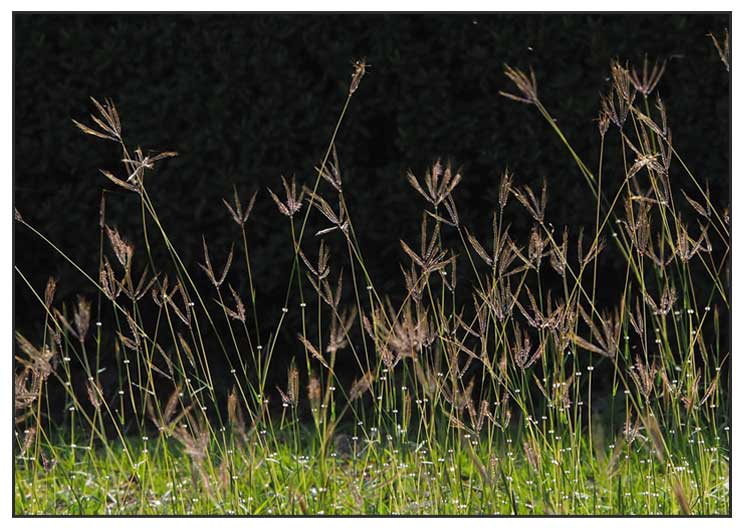
Gen info
-
Poaceae, also called Gramineae, is a large and nearly ubiquitous family of monocotyledonous flowering plants commonly known as true grasses. It includes the cereal grasses, bamboos, natural grassland grasses, and species cultivated in lawns and pastures. It is the 5th largest plant family, after Asteraceae, Orchidaceae, Fabaceae, and Rubiaceae.
- Dichanthium, commonly known as bluestem or bluegrass, is a genus of African, Asian, and Australian plants in the grass family.
Some species have become naturalized in the Americas and on various oceanic islands. (11)
- Dichanthium annulatum is a species of grass in the Poaceae family.
- Etymologies: The genus Dichanthium derives from Greek words dicha, meaning "in two" or "asunder" and anthos, meaning "flower", referring to the two different types of spikelet pairs found in the flower cluster (raceme). The specific epithet annulatum derives from Latin words annulus, meaning "ring" and suffix -ata, meaning "possessing" or "having", alluding to the ring-like appearance of the bearded or hairy nodes along the grass stems. (•) The common name Blue Stem derives from the narrow and elongated leaves, often with a bluish-green hue. (•) Alabang Grass may derive from its association with its close relative and pasture strain Dichanthium aristatum, called Alabang X, and its historical association with the Alabang Stock Farm in Muntinglupa, Metro Manila.
 Botany Botany
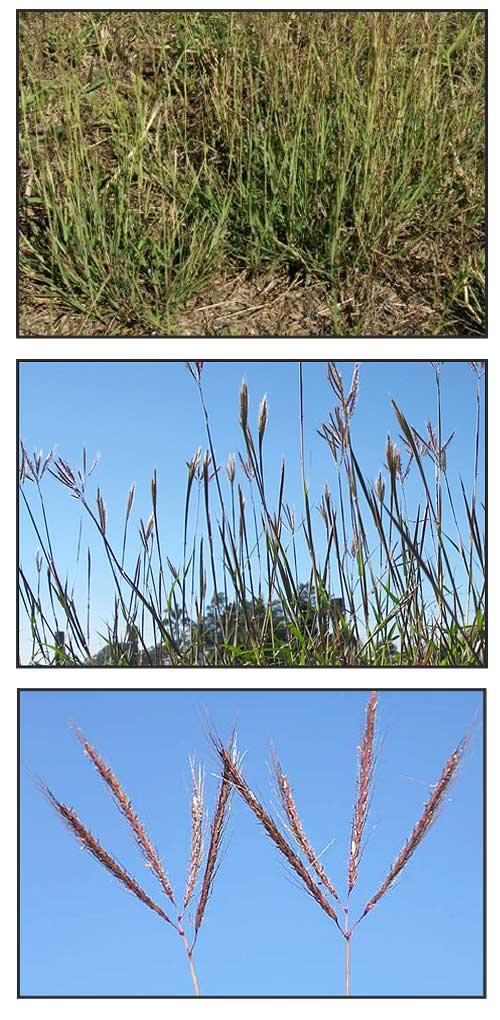
• Species is quite variable. In general, it is a perennial grass often with stolons. Stems spread outwards, then grow erect at the ends, sometimes a meter long and reach about 60 centimeters in erect height. Each node on the stem is encircled with a ring of hairs. Rough-haired leaf blades are up to 30 centimeters long. Inflorescence is an array of purplish or green branches each up to 7 centimeters long, generally 2 to 9 branches, but sometimes up to 15. Spikelet may be well over 2 centimeters long, including its long awn. Awn is twisted and has two bends in it. Root system goes no deeper than one meter. (3)
• The grass often reproduces by apomixis, producing seeds without fertilization. It does reproduce sexually at times. Plants can be diploid, tetraploid, or hexaploid. (3)
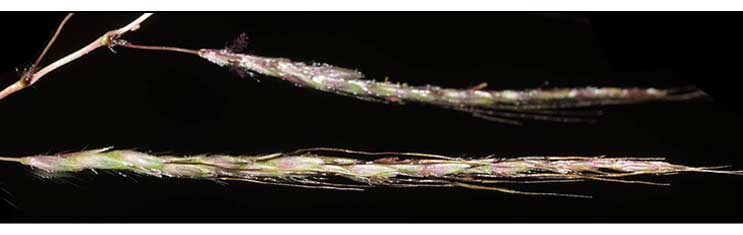
• A perennial grass, often tufted, spreading and stoloniferous, with erect, branched or rarely geniculate culms up to 1 m tall, hairy at the nodes. Leaf-sheath terete, 3-4 cm long, sparsely hairy at the margins; ligule truncate, 2-4 mm long, membranous; leaf-blade linear, 3-30 cm x 2-8 mm, often hairy above, at the margins and in the throat. Inflorescence composed of up to 15 subdigitate, shortly peduncled racemes each 3-7 cm long; spikelets paired, one pedicelled, one sessile, alternately arranged along a filiform axis; the lowest 1-2 pairs similar, male or neuter, awnless and persistent; all other pairs dissimilar and deciduous; sessile spikelet 2-5 mm long, bisexual, upper lemma with a 1-2.5 cm long, kneed and twisted awn; pedicelled spikelet male or neuter; lower glumes pubescent to villous in lower half, upper half with long bulbous-based hairs especially on the margins. Caryopsis obovoid. (4)
Distribution
- Native to the Philippines. (1)
(2)
- In Luzon: Albay, Benguet, Bulacan, NCR, Nueva Ecija, Pangasinan, Rizal, Mindoro.
- Native range is Tropical and Subtropical Old World; a perennial or rhizomatous geophyte that grows primarily in seasonally dry tropical biome. (2)
- Also native to
Afghanistan, Algeria, Andaman Is., Angola, Assam, Bangladesh, Borneo, Botswana, Cape Provinces, Cape Verde, Caprivi Strip, Chad, China South-Central, China Southeast, Comoros, Djibouti, East Himalaya, Egypt, Eritrea, Eswatini, Ethiopia, Free State, Guinea, Gulf States, Hainan, India, Iran, Iraq, Ivory Coast, Jawa, Kenya, Kuwait, KwaZulu-Natal, Laos, Lebanon-Syria, Lesser Sunda Is., Libya, Madagascar, Malawi, Malaya, Mali, Mauritania, Mauritius, Morocco, Mozambique, Myanmar, Namibia, Nepal, New Guinea, Nicobar Is., Niger, Northern Provinces, Oman, Pakistan, Palestine, Réunion, Saudi Arabia, Senegal, Sinai, Socotra, Somalia, South China Sea, Sudan-South Sudan, Sulawesi, Taiwan, Tanzania, Thailand, Tunisia, Türkiye, Uganda, Vietnam, West Himalaya, Yemen, Zambia, Zimbabwe. (2)
- Invasiveness: It can aggressively outcompete many other plants. It can escape cultivation and become a weed. It is an invasive species in Fiji, Hawaii, and New Caledonia, and has displaced native grasses in large areas of south Texas. It is cited as a factor in the decline of the slender rushpea (Hoffmannseggia tenella), a federally listed endangered plant of the United States. (3)
 Constituents Constituents
- Nitrogen concentrations range from 0.4 - 1.7&, depending on stage of growth. (4)
- Study isolated two pairs of lignoflavone derivative stereoisomers; an epimers of tricin 4`-O-(threo-β-guaiacylglyceryl) ether (Salcolin A) and tricin 4`-O-(erythro-β-guaiacylglyceryl) ether (Salcolin B) (1) and an epimer of tricin 4`-O-[threo-β-guaiacyl-(7``-O-methyl-9``-O-acetyl)-glyceryl] ether and tricin 4`-O-[erythro-βguaiacyl-(7``-O-methyl-9``-O-acetyl)-glyceryl] ether (2), one flavone; tricin (3), two flavone glycosides; tricin 7-O-β-D-glucopyranoside (4) and tricin 7-O-neohesperidoside (5), one flavone C-glucoside; isoorientin (6), one phenolic acid; p-coumaric acid (7), one lignan; 4-ketopinoresinol (8) and two sterols; stigmasterol (9) and β-sitosterol-3-O-β-D-glucoside (10). (see study below) (6)
- Phytochemical screening of methanol extract of whole plant revealed carbohydrates, flavonoids, alkaloids, and phenolics. Total phenolic content was 76.23 mg GAE/g DW.
Properties
- Studies have suggest antimicrobial, cytotoxicity, antiviral, anticancer, α-amylase inhibitory, antidiabetic properties.
Parts used
Leaves, aerial parts.
Uses
Edibility
- While valued as high-quality livestock forage, it is not used as human food.
Folkloric
- No reported medicinal use in the Philippines.
-
In Pakistan, whole plant used for dysentery and menorrhagia. (9)
-
Aerial parts used as folk remedies for treating fever, rheumatism, and skin conditions.
Others
- Forage: Commonly used as forage for grazing livestock; cut for hay and silage. Horses and cattle find it very palatable. (•) It is drought-tolerant, persistent, and resistant to heavy grazing. (3)
- Agroforestry: While it can aggressively outcompete many other plants, the grass can be used to revegetate degraded grasslands. It is a very effective binding plant for erosion control. (3) It helps binding the soil even on 20° slopes. Also a good grass for ground cover.(Also, see study below: 12)
Studies
• Antimicrobial / Antiviral / Cytotoxicity / Aerial Parts: Various extracts and fractions were evaluated in vitro against different bacteria and fungi using diffusion agar technique. Ethyl acetate and n-butanol extracts showed weak antiviral effects against HAV-10 and no activity against HSV-1 and HSV-2. The extracts showed variable antimicrobial activity against most of the tested bacteria. Ethyl acetate extract was most active against C. albicans and E. coli. EA and n-hexane extract were most active extracts as cytotoxic agents against tested cell lines (HepG-2, HCT-116, and MCF-7) with IC50s from 5.42 to 12.0 µg/ml. The higher activities of the ethyl acetate extract was attributed to flavolignan and flavonoid contents. (see constituents above) (6)
• Toxicity Study / Whole Plant: Study evaluated the acute oral toxicity of crude extracts in doses of 250, 500, 1000, 2000, 4000, and 8000 mg/kbw delivered by in 200 µl gavage to mice. Results showed no adverse effects in terms of observable changes in behavior, cutaneous or gastrointestinal effects up to 2000 mg/kg. At 4000 and 8000 mg, there was increased water intake. No mortality was recorded. (6)
• Potential Anticancer Effect: Study evaluated the cytotoxic effect of methanolic extract of Dichanthium annulatum in vitro by MTT assay on two cell lines: SR (Lymphoma) and L20B (Murine fibroblast). Results showed cytotoxic effect against SR cell line in low concentrations (3.125, 6.25 µg/ml) which was 55% and 46% and against L20B at 60% and 59%. Results showed good potential anticancer effect. (8)
• Antidiabetic Effect / α-Amylase Inhibitory / Leaves: Study evaluated the in-vitro antidiabetic activity of ethanol extract of leaves of D. annulatum. The extract showed alpha-amylase inhibitory activity with IC50 of 100 µg/mL, compared to Acarbose IC50 65.454 µg/mL. (10)
• Efficacy of D. annulatum Watercourses for Reducing Sediment Delivery from Agri-Watersheds: Study evaluated the efficacy of DA grass filters and optimization of coverage in watercourses. Results showed grass filter strips are able to reduce sediment concentration in runoff water by six times (from 4.2 to 0.65 g/L), reduce velocity of runoff water by two times (1.06 to 0.47 m/s), and convert supercritical flows into subcritical flows. Results suggest potential use of filters in watercourses to prevent runoff and soil losses from crop fields and reducing sedimentation of downstream water bodies. (12)
Availability
- Wild-crafted.
|